The house was steeped in that heavy, midday quiet that makes every creak feel like a confession. I stood at the foot of our bed, mechanically folding Leo’s tiny T-shirts into a neat stack. On the dresser, my mother’s silk scarf lay in a loose coil, still holding the ghost of her jasmine perfume—three months in the ground, and yet she lingered in that bottle.
Before I could stop myself, I lifted the fabric to my face and breathed her in.
“Mommy, are you crying again?”
Leo materialized in the doorway, clutching a juice box like a trophy, his socks a mismatched riot of blue and stripes.
“No, baby. Just smelling Grandma.”
“Grandma smells like flowers,” he announced, padding across the room to climb onto the bed.
That was when I spotted it—a dried, peeling smear of silver paint along his thumb, and another crusted streak near his elbow. It had not been there when I bathed him the night before.
“Leo, what is this?”
“Paint.”
“I can see it’s paint. From where?”
“Art class,” Mark interjected, appearing in the hallway behind our son with a coffee mug in one hand and his phone in the other. “The teacher’s been doing a whole galaxy unit this week. Stars, planets, the works.”
He gave me that smile—small, private, the corners of his mouth tucked inward as if suppressing a secret. “It looks stubborn. Doesn’t it wash off?”
“You know how he is in the tub. Splashes everywhere except on himself.”
“I did!” Leo shouted, bouncing off the bed and tearing downstairs.
Mark leaned in and pressed a quick, warm kiss to my forehead. “You look tired, Ket.”
“I’m fine.”
“Our anniversary is in three days. Ten years. Are we doing something, or are you going to keep pretending you forgot?”
“I haven’t forgotten.”
“Good.” He glanced at his phone again, that same soft smile flickering across his lips, then slipped the device into his back pocket before I could catch a glimpse of the screen. “I have to run out for an hour. Errand.”
“On a Wednesday morning? Don’t you have work?”
“A boring one. Promise.”
I watched him leave and told myself I was being absurd. Grief made strangers of the most familiar people. My mother used to say that suspicion was simply love with nowhere to land, and lately, my love seemed to have no anchor at all.
—
That evening, I carried a stack of clean towels toward the guest room, but the door refused to budge.
“Mark?” I called. “Why is the guest room locked?”
“Is it?” His voice drifted up from downstairs, casual and unconcerned. “Must’ve stuck. I’ll take a look in a minute.”
“Do you have the key?”
“Somewhere,” he replied. “Don’t worry about it.”
I kept my hand on the cool brass doorknob for a long, suspended moment. Then I walked away, because that was what a sensible wife did. That was what a woman who trusted her husband was supposed to do.
By the following afternoon, I had nearly convinced myself that nothing was amiss.
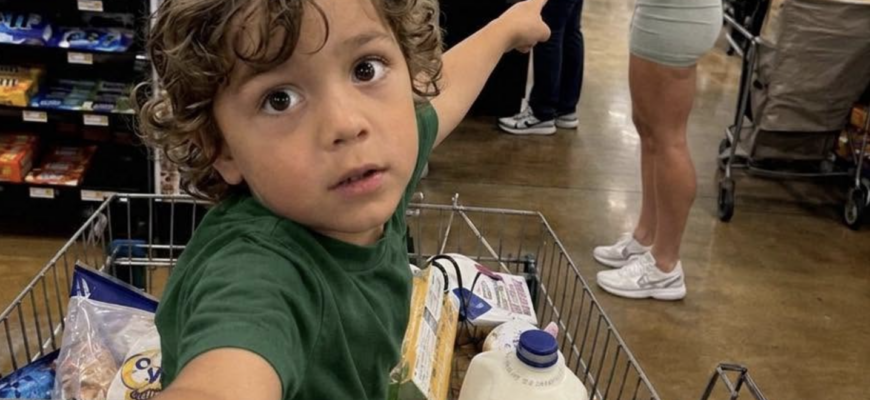
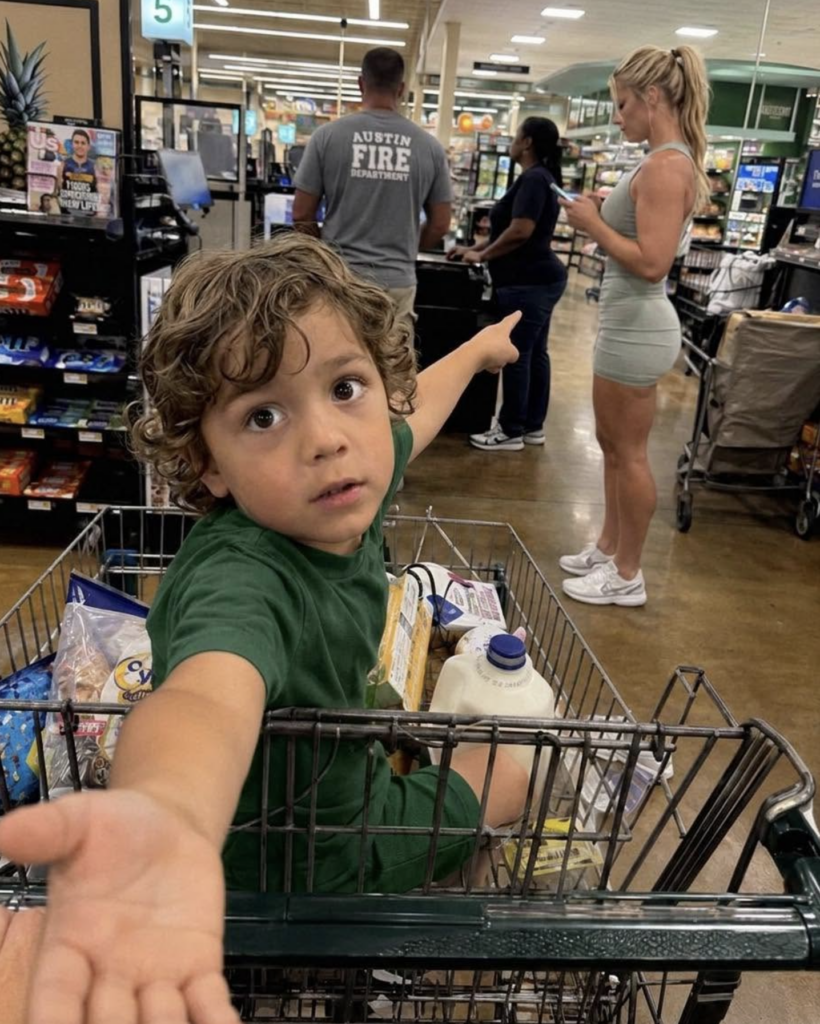
“Milk, apples, bread, and something for dinner,” I recited to Leo, buckling him into the grocery cart. “Help Mommy remember.”
“Milk, apples, bread,” he sang, kicking his legs in a cheerful rhythm.
The supermarket buzzed with its usual symphony—squeaking cart wheels, a baby wailing two aisles over, a thin pop song crackling through the overhead speakers. I placed a carton of milk into the cart and joined the checkout line, and for the first time in weeks, the pressure in my chest eased. Almost peaceful. Almost normal.
Then Leo went utterly still.
He grabbed my sleeve and yanked hard. “Mommy. *Mommy, look.*”
The cashier’s scanner beeped somewhere behind me, but the noise felt distant, belonging to someone else’s afternoon.
“I see her, sweetheart,” I whispered. “Keep your voice down.”
“But that’s *her*,” he insisted, pointing toward the bakery display. “That’s the lady who comes to our house when you’re at work! She plays in the room upstairs.”
My hand clenched around the milk carton so fiercely that the cardboard began to buckle. I set it on the conveyor belt before I crushed it entirely.
The woman near the bakery hadn’t turned around. She looked young—perhaps thirty—with dark hair loosely pinned up, wearing a short green dress, a canvas tote hanging from one shoulder. I couldn’t see her face. I wasn’t sure I wanted to.
I crouched down to Leo’s eye level. “Leo, honey. What do you mean, *plays*?”
“Games,” he answered casually, swinging his legs. “But Daddy said it’s a secret. So I’m not telling.”
“You just told me.”
His mouth opened, then closed. His eyes widened with the particular terror of a five-year-old who had just realized he’d broken a cardinal rule. “I didn’t mean to,” he whispered.
Ten years. Ten years of Sunday mornings, burnt pancakes, and Mark rubbing my back when I couldn’t sleep after my mother’s funeral. And now my son was telling me another woman visited our house while I was at work.
The cashier spoke, but her words swam through static. “Ma’am? Ma’am, your total. Forty-two eighteen.”
I fumbled for my card, dropped it, picked it up, and tapped it against the reader with a hand that would not stop trembling. The machine chirped its cheerful approval. The cashier bagged the groceries and returned them to the cart without meeting my eyes.
“Mommy, are you mad?”
“No, baby.”
“You *look* mad.”
“I’m not mad at you.”
The truth was, I had bypassed anger entirely and landed somewhere colder—a numb, clinical space where every good memory of my husband quietly reshaped itself into evidence. The silver paint on Leo’s fingers. Mark’s dismissive laugh. The locked guest room. That private smile at his phone while I poured my coffee.
My mother had been gone for three months, and for three months I had blamed the strange imbalance in our home on grief. On myself. On the empty chair at family meals and the fading perfume trapped in a silk scarf.
I looked toward the woman again. She had picked up a loaf of sourdough and was turning it over in her hands, studying the label.
“Leo,” I said softly. “How many times has the lady come over?”
He counted on his fingers, lost track, then started over. “A lot. But only when you’re at work. And she brings the tall bag.”
“What tall bag?”
“With the sticks in it.”
Sticks. Paintbrushes, perhaps. Or something else entirely. My mind refused to settle on any harmless explanation.
I pushed the cart toward the exit. Then I stopped. My feet simply refused to carry me further. I could walk away. I could buckle Leo into the car, drive home, and pretend I had never heard any of it. I could confront Mark that evening in our kitchen, where the lighting was soft and I felt steady.
Or I could turn around now, ten feet away from a stranger who might already know more about my marriage than I did, and demand the truth from her.
“Mommy?”
“One second, sweetheart.”
I closed my eyes and thought of my mother, who used to say that anything worth knowing was worth knowing today.
I turned the cart around.
My legs felt disconnected from my body as I approached the bakery display. Leo fell silent, sensing the shift in me the way small animals sense an approaching storm. Ten feet. Six feet. Three.
“Excuse me,” I said. My voice came out thinner than I intended.
The woman did not turn.
“*Excuse me.*”
She looked up, distracted, still holding the loaf of bread. Her eyes passed over me and landed on Leo. Something flickered across her face—recognition, soft and startled, like the expression someone gives a child they have only ever seen in photographs. Then she looked back at me and understood exactly who I was.
“Oh,” she said quietly.
“Do you know my son?”
She slowly returned the bread to the shelf, as if buying herself a few extra seconds. “I… I think you should call your husband.”
“I’m asking *you*.”
She did not answer. The sound of my husband’s existence inside her silence had already fractured something in my chest. I could feel Leo watching me, the fluorescent lights humming overhead, yet I could not force out another word.
She noticed. Whatever she saw on my face softened her expression into something almost gentle. Almost apologetic. She smiled—a small, warm, unreadable smile. Standing there beside my son and a carton of milk, I could not tell whether it was the smile of a stranger offering kindness, or the smile of a woman quietly dismantling my life.
“Who are you?” I asked, my voice low and unsteady.
“I’m sorry?”
“*Who. Are. You.*” I moved closer until Leo’s swinging feet brushed against my hip. “My son says you come to my house when I’m at work. So who are you?”
Her expression shifted—not guilt, exactly, but a controlled, guarded stillness. She glanced at Leo, then back at me. “My name is Nora,” she said quietly. “I’ve been doing some work for Mark. It’s private, and he asked me not to say anything. I gave him my word.”
*Private.* The word slipped beneath my ribs like a blade.
Leo had become very still in the cart, watching me with the wide-eyed fear he always showed when adults used the wrong tone. “Mommy?”
“It’s okay, baby.”
It was not okay. I stared at Nora, memorizing her face, the paint beneath her thumbnail, the loose braid resting over her shoulder. Then I spun the cart around and hurried out of the store.
“Mommy?” Leo called.
I didn’t answer. I kept pushing until we reached the parking lot. My fingers shook uncontrollably as I strapped him into his car seat. Once behind the wheel, I pulled out my phone and called Mark. Voicemail. I called again. Voicemail. On the third attempt, the same polite recorded voice invited me to leave a message, but I could not find a single sentence large enough to contain what I felt.
“Where is Daddy?” Leo asked from the back seat.
“I don’t know, sweetheart.”
“Is Daddy in trouble?”
I looked at him through the rearview mirror. “Why would Daddy be in trouble?”
He hesitated, chewing the inside of his cheek exactly the way Mark did. “I wasn’t supposed to tell about the lady.”
“I know, baby.”
“Daddy said it’s a surprise. He said if I told, the surprise would be broken.”
—
The drive home lasted only seven minutes, but it stretched into an hour. All I could picture was the locked guest room. When we arrived, I left the groceries in the car and carried Leo inside on my hip.
“Stay down here,” I told him, depositing him on the couch and switching on the television. “Mommy needs to check something.”
I climbed the stairs two at a time. The guest room door remained locked. I shook the handle, twisted it until my wrist ached, then pressed my forehead against the wood and tried to breathe. “Mark,” I whispered into the empty hallway. “What did you do?”
Small footsteps sounded behind me. Leo had followed, one hand curled around the banister. “Mommy,” he said in the overly loud whisper that five-year-olds believe is quiet. “I’m not supposed to say.”
“Leo, honey, please go back downstairs.”
“But there’s a surprise inside.” He climbed the final two steps. “Daddy has the key. He keeps it in his work bag. He said only him and the lady can open it ’cause the surprise isn’t done.”
I shut my eyes. Every clue lined up, neat and damning, forming a picture I had already finished painting in my mind. A locked room. A hidden key. A woman visiting only when I was gone. A child instructed to keep quiet. A husband who would not answer his phone.
I lowered myself onto the top step. Leo sat beside me and rested his warm head against my arm. “Are you mad, Mommy?”
“I’m not mad at you.”
“Are you mad at Daddy?”
I did not respond.
Downstairs, I sat on the bottom step and silently rehearsed sentences I had never imagined saying. *I want a separation. I think you should stay somewhere else tonight. Please do not lie to me—not today, not this week.* Ten years. Our anniversary was Saturday. I had bought him a watch with his name engraved on the back.
Leo wandered in carrying his stuffed rabbit and climbed into my lap without a word. That was what finally broke me—more than the locked room, more than the mysterious woman in the green dress. He knew something was wrong and was trying to repair it with a stuffed rabbit.
Then my phone vibrated against my leg. For a moment, I almost ignored it. When I finally looked, my hand turned cold.
Mark had sent me a photograph.
It showed the guest bedroom from the doorway. Half of one wall was covered in unfinished brushstrokes—soft blues, warm browns, and the beginnings of a woman’s face. A face with kind eyes I would have recognized anywhere. My mother’s eyes.
Beneath the photo were four lines:
*“I took this yesterday.”*
*“I wasn’t ready to show you yet.”*
*“Please go upstairs.”*
*“I love you.”*
I opened the picture again. The blue paint. The silver stars. The smudge on Leo’s thumb. The locked guest room. Nora’s paint-stained hands. Every clue I had spent the past hour arranging into proof of betrayal suddenly reorganized itself into something entirely different.
I pressed my hand against my mouth. “Oh, God.” The words barely escaped. I had been wrong. Not slightly wrong. Completely wrong.
I looked toward Leo. He was curled on the couch with his stuffed rabbit, watching me with anxious eyes. “Mommy?”
I swallowed the pressure in my throat. “Come on, sweetheart,” I said quietly. “We’re going back to the store.”
He tilted his head. “To see the paint lady?”
I nodded. “Yes. I think… I owe her an apology.”
—
Twenty minutes later, I found Nora in the supermarket parking lot, folding a paint-stained cloth into the trunk of a small blue car. My legs felt borrowed as I approached her.
“I’m so sorry,” I said before she had fully turned around. “I said terrible things. I thought—”
Nora gave me a calm, gentle smile. “Mark found me four months ago,” she said. “He brought me a shoebox of your mother’s photographs. He asked if I could put her on a wall so you’d see her every night.”
Tears flooded my eyes. Leo pressed quietly against my leg.
“The stars,” Nora said, crouching to his height. She took a slender brush from her apron and placed it in his hand. “Your daddy told this little man that Grandma loved stars. He’s been sneaking upstairs to help me paint them.”
Leo held the brush as though it were something sacred. “I wasn’t supposed to tell,” he whispered.
“You didn’t tell the important part,” Nora said. “You saved that for tonight.”
—
My hands trembled on the steering wheel during the drive home. Mark was waiting on the porch, his face pale. “I’m sorry,” he said. “I should have—”
“Take me upstairs,” I said.
He unlocked the guest room.
My mother looked back at me from the wall. Her eyes were exactly as I remembered them when she stood at the kitchen window, warm and knowing. Above her stretched a ceiling filled with half-finished silver stars, scattered across the plaster like a private galaxy.
I lowered myself to the floor and finally cried the way I had refused to cry for three months.
Mark knelt beside me. “I didn’t know how to reach you,” he said. “You went so quiet.”
“I know,” I whispered. “I went quiet from myself, too.”
Leo climbed onto the bed and dipped his brush into a small jar of silver paint. “Mommy,” he said. “Come finish the last one with me.”