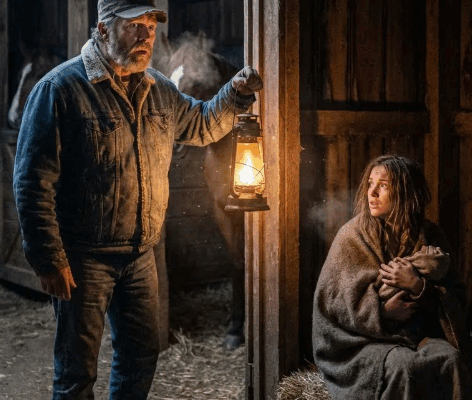
Her lips trembled. Tears gathered but she swallowed them back with a kind of practiced strength. James stood and glanced toward the farmhouse—the kitchen window a dark square against the distance.
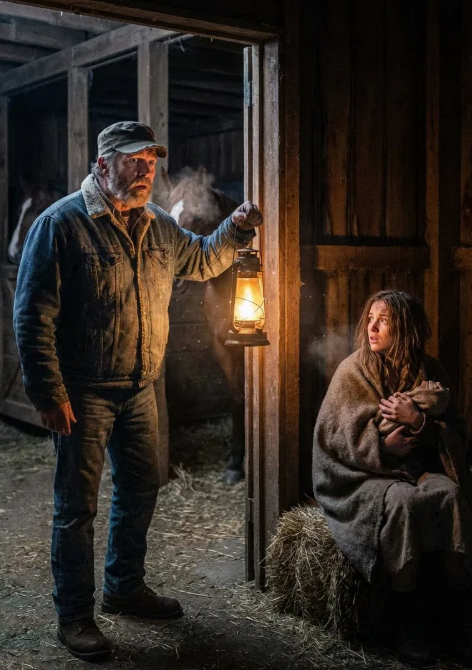
“Can you walk?” he asked.
She hesitated, then nodded, struggling to her feet. She wavered, clutching the baby tightly. James offered his arms. For several long seconds she hovered between fear and hope—then carefully laid the child in his hands. It was a small act, but it was trust.
The baby—Grace, though he didn’t yet know her name—settled peacefully against his chest as if she already believed him. “Come on,” James murmured, turning toward the house. “Coffee’s waiting on the stove.”
They crossed the frozen yard, his boots cracking over frost, her steps light and unsure behind him. The barn door closed with a dull thump. A lamp flicked on in the kitchen, casting warm, golden light over the snow like a welcome.
“Sit,” he told her, nodding to the table. She moved like something wild, ready to run at the slightest sound, but she obeyed.
James warmed milk, poured coffee, sliced yesterday’s bread. He set out butter, jam, the little he had. He tested the milk on his wrist before offering it.
“What’s your name?” he asked.
“Sarah.” Her hands shook as she reached for the bottle. “And the baby’s Grace.”
She fed Grace first, even though hunger made her whole body tremble. James saw it clearly: a mother who’d put her child before anything, even her own survival. He nudged the bread closer. “Eat.”
She shook her head. “I don’t eat until she does.” Not defiant—just truth.
Eventually she ate, small bites at first, like someone who’d forgotten what it felt like to be full.
James didn’t press her with questions. They could wait.
For eight years he’d set only one plate at that table. One cup.
Tonight there were three people in his kitchen, and the house felt alive again.
Grace finished the milk and drifted toward sleep. Sarah held her close, rocking without realizing she was doing it.
“There’s a room upstairs,” James said. “Stove in there too. I’ll light it. You can stay until you’re ready to travel.”
Her eyes filled again. “I got nowhere to go.”
James met her gaze, reading the fear, the exhaustion, the flicker of hope she hardly dared to trust.
“Then you’ll stay,” he said simply.
He showed her to the room—Martha’s old sewing room, untouched for years. The blankets were clean. The stove warmed quickly. Sarah stood in the doorway like she’d stepped into a memory that wasn’t hers.
“Thank you,” she whispered.
James nodded and left her to rest. Downstairs, he sat beside the fire and listened: the creak of floorboards, running water, Grace’s small sigh. The house held life again. Something in his chest felt tight, but not with grief—with something he thought he’d buried years ago.
Hope.
Purpose.
For the first time in eight years, he wasn’t alone on Thanksgiving.
Morning found Sarah in the kitchen, Grace in her arms. She startled when James came downstairs but didn’t flee.
“Thought maybe you’d leave,” he said. “Daylight makes it easier.”
She looked through the frost-covered window. “I should.”
Then quietly, almost relieved: “Storm’s coming.”
He poured coffee. “Sky says so.” It was true—clouds gathered low and heavy—but he would’ve said it anyway.
They ate in near silence. Grace slept in a drawer James had lined with blankets—the safest place he could think of. Sarah checked on her every few minutes.
“Can I ask,” James began softly, “where you were headed?”
“Anywhere.” Sarah traced the rim of her cup. “Just… away.”
“From what?”
She was silent a long time.
Finally she said, “Grace’s father. He’s not… he isn’t a good man. Hit me while I was carrying her. Worse after she came.”
James’s jaw tightened.
“My family said I shamed them. Turned me out. I had Grace alone. In a line shack in the middle of nowhere.”
She swallowed. “Been walking ever since she was strong enough to travel.”
Three months old, James realized. She’d walked through winter with an infant.
“I’m sorry,” he said.
She blinked, surprised. “You didn’t do it.”
“Still sorry it happened.”
They sat quietly with that truth.
Then Sarah asked, “Why help me? The town won’t like it. Man living alone, taking in a girl and her baby… they’ll talk.”
“Had a wife once,” James said. “Martha. And a daughter on the way. Lost them both eight years ago. Childbirth took ’em.”
Understanding—not pity—crossed her face.
“House got real quiet after that,” he continued. “Doesn’t matter how hot the fire burns.”
He met her eyes. “Don’t recall needing the town’s blessing to do what’s right.”
Sarah gave a small, real smile. “They’ll talk anyway.”
“Let them.”
Snow began to fall, heavy and slow.
James stood to clear the plates. “I make coffee a particular way. Want me to show you?”
He walked her through the steps. She watched carefully, learning his steadiness. When it was done, she made the next pot just the way he liked.
Outside, snow fell in thick sheets, erasing the tracks she’d made to his door—wiping the past clean.
She wasn’t leaving. And neither of them wanted her to.
Two weeks passed smoothly, the house finding its rhythm. Sarah learned which floorboards creaked, how James liked his bacon, where he kept the flour. She helped with chores, tended fires, cared for Grace. Small things, but they changed everything.
James taught her to make biscuits. “More buttermilk,” he’d say. “Fold it—don’t beat it to death.”
Her third batch came out perfect. James ate four without a word, which was the highest praise he ever gave.
Grace began smiling—first at Sarah, then one morning at James. She reached for him with tiny hands, and something in him cracked open.
“She likes you,” Sarah whispered.
He couldn’t speak. Holding Grace felt like holding a future he’d thought he’d lost forever.
But peace never lasts untouched.
The pastor’s wife visited with “charity”—blankets, jars, and sharp judgment in her eyes.
“Didn’t know you had family visiting,” she said pointedly.
James’s reply was flat. “Didn’t know I had to announce it.”
By the time she left, the story was already halfway to town.
“They’ll talk now,” Sarah said softly.
“Let them.”
“It’ll make things hard for you.”
James looked at her—really looked. Sarah had more color in her cheeks now. Grace was thriving. His house no longer felt like a tomb.
“Don’t care what they say,” he said. “Care what’s true.”
Ben came the next day with the town’s unease. Council’s talking… improper… unmarried girl with a baby…
James only said, “I know who I am. That’s enough.”
Later, Sarah caught him watching her hang laundry—his shirts beside her dress, Grace’s tiny clothes mixed in. It looked like a family.
“I can hang mine separate,” she offered.
“No,” he said. “Leave them.”
She understood. And she smiled.
As Christmas neared, the house filled with pine boughs and the scent of warmth. Sarah told her story in pieces: the charming ranch hand who turned violent, the night she fled with nothing but Grace and a shawl.
“I was stupid,” she whispered.
“No,” James said firmly. “You survived. You kept Grace safe. That’s courage, not foolishness.”
She looked at him then, and something shifted between them.
One night Grace wouldn’t sleep. Sarah walked and sang until her voice thinned. At midnight James appeared.
“Let me,” he said softly.
Grace quieted as he walked her through the lamplight, singing an old hymn he hadn’t sung in years. Sarah watched, her heart breaking open with love she hadn’t expected.
She loved him.
And it terrified her.
James laid Grace down gently. Their eyes met. Something unspoken passed between them.
Later, in the barn, he whispered into the dark, hands shaking:
“I can’t lose anyone else. Can’t bury another family.”
Fear clawed at him. Loving them meant risking everything.
He visited Martha’s grave the next morning, brushed off the snow, laid winter greenery across the stone.
“I think you’d want me to live again,” he said. “I think I’m ready.”
The truth lingered in the cold.
“I love them,” he whispered. “Both of them. Like they’re mine.”
He walked home through falling snow to the lamplight waiting in his window—his heart already there.
The council arrived after church on Sunday, six men with stiff faces.
“Need to talk,” Elder Morrison said. “About the girl. About Sarah.”
“Then talk,” James answered.
“She’s been here nearly a month. Folks think it’s improper. A woman with a child that ain’t yours. Living in your home. It’s shameful.”
James’s voice stayed steady. “She’s family.”
“She isn’t married to you. Baby’s not yours. This can’t continue.”
James looked each man in the eye. “She’s staying. That’s the end of it.”
Morrison bristled. “Town won’t like it.”
“Town doesn’t eat at my table.”
He walked away, though his hands shook.
That night Sarah overheard him speaking to Ben on the porch.
“They want her gone,” James said quietly. “Want me to turn her out.”
Sarah’s heart twisted.
She should have known.
Should have left before it cost him everything.
She made her decision quickly:
Better for her to go
than destroy the man who saved her.