
“Sir, do you need a maid? I can do anything… my sister is hungry.”
The words stopped Edward Hale, a forty-five-year-old billionaire, mid-step at the gates of his London mansion. He turned and saw a young woman no older than eighteen, her dress ragged, dust smeared across her face. A baby, wrapped in a faded cloth, slept against her back, its breaths delicate and slow.
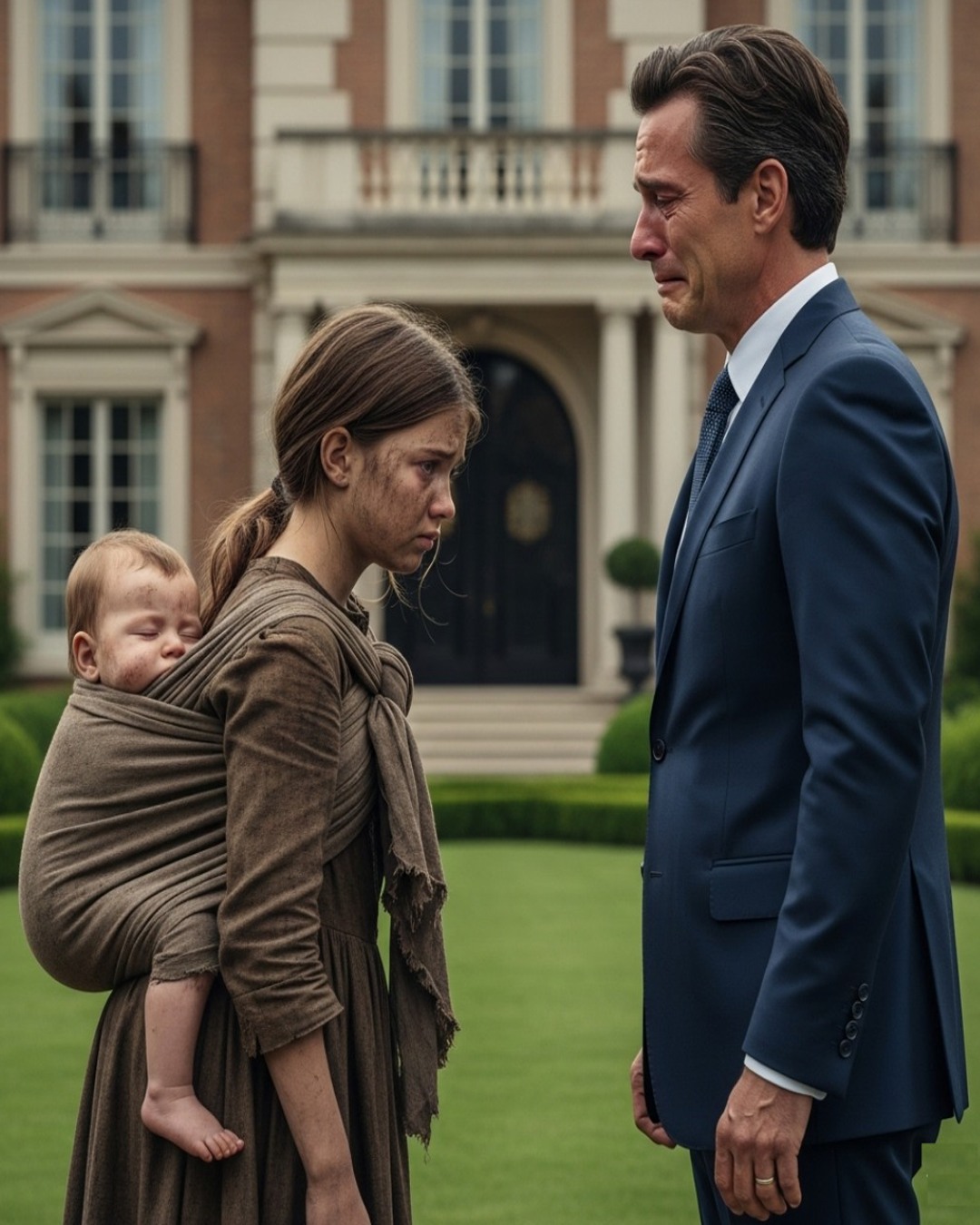
Edward’s first reaction was disbelief — he wasn’t used to strangers addressing him so plainly. Then his gaze landed on a small, crescent-shaped birthmark at the girl’s neck. It was the same mark his late sister, Margaret, had borne. A memory he had never made peace with flared up: Margaret had died almost twenty years earlier in an accident that left questions he’d never answered.
“Who are you?” he asked, the words rougher than he intended.
The girl flinched and tightened her hold on the baby. “Lena Carter. Please, sir. We have no one. I’ll clean, cook, scrub floors — anything. Just don’t let my sister go hungry.”
There was something in her face — a resemblance, the mark, the raw plea — that tugged at Edward beyond sympathy. He motioned for his driver to wait, crouched so their eyes were closer, and asked quietly, “That mark on your neck… where did it come from?”
Lena’s lips trembled. “It’s been there since I was born. My mother said it ran in the family. She told me once she had a brother, but he left before I could remember.”
Edward felt the room tilt. His sister’s name had been Margaret Elena Hale; in youth she’d often used Elena. Could this ragged girl be connected to the sister he’d lost — the sister he’d never tried hard enough to find?
He asked about Lena’s parents. Her voice softened. “My mother was Elena Carter. She was a seamstress. She died last winter — illness. She never talked much about family except that she had a brother who got rich and… forgot about her.”
The name Elena landed like a stone. Lena’s mother had the same mark; she had covered it with scarves. The evidence closed in around Edward. This was no accident: the girl and the baby were his blood.
“Why didn’t she reach out?” he muttered.
“She said you wouldn’t care,” Lena whispered. “People with money never look back.”
The confession cut deeper than any boardroom loss. Edward had spent his life building fortunes; he’d assumed the wounds of the past were mutual. Now, face to face with the result of his absence, he realized how wrong he’d been.
“Come inside,” he said at last, voice breaking. “Both of you. You’re family.”
Lena’s guarded façade broke. She had expected only indifference or cruelty; instead she found the tentative warmth of a man finally owning a mistake. He brought food to the gate; she ate ravenously, feeding crumbs to the baby whenever it stirred. When she could speak, Edward discovered not just desperation but resilience and fierce protection. The infant — Amelia — laughed at his awkward attempts to amuse her. Lena, still wary, began to accept help.
Edward hired tutors for Lena and told her, gently, “You don’t need to scrub floors. You need to study, to have choices. This isn’t charity. It’s what I should have done for your mother.”
One evening in the garden, he could no longer hide the truth. Tears came unbidden. “I was your mother’s brother,” he said. “I failed her… and I failed you.”
Lena looked at him, then down at the grass. “She never hated you,” she said softly. “She thought you didn’t want her.”
The words were both accusation and absolution. From that moment forward, the mansion — once a monument to possession — filled with the messy, stubborn life of family: late dinners, baby cries, lessons, and the slow work of making amends. Edward discovered a wealth he had never owned before: belonging.
Short version (for a blurb)
At his London gate, billionaire Edward Hale is stopped by a ragged teenager begging for work to feed her baby sister. One look at the crescent birthmark at her neck — the same his late sister had — forces Edward to face a past he ignored. What begins as a plea for food becomes a chance at redemption when family, long forgotten, returns.