Prom night was supposed to be magical. Instead, one cruel act almost shattered everything—until my father quietly taught her a lesson she never saw coming.
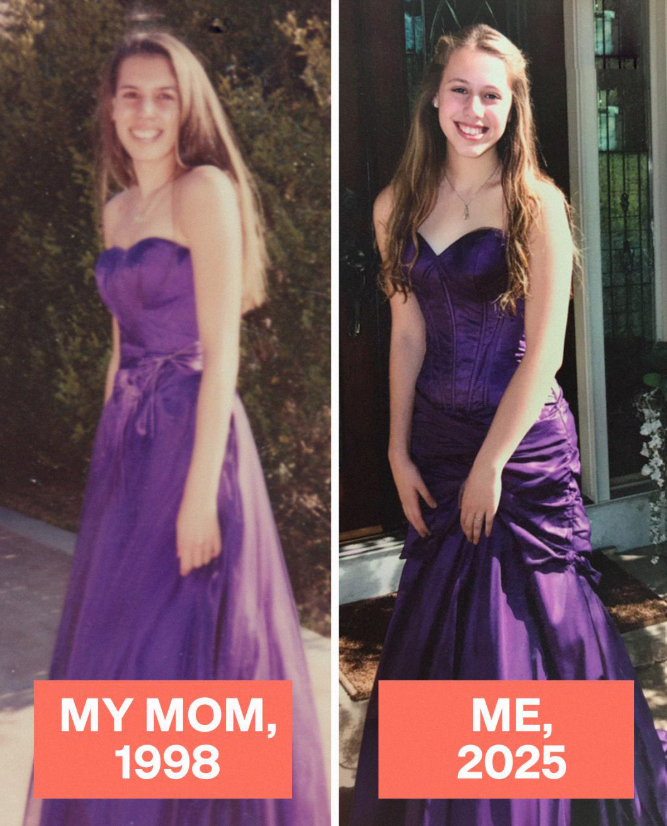
I’m Megan, seventeen. For most girls, prom means new dresses, frantic beauty prep, and photos in front of flower walls. For me, it meant one thing: my mom’s prom dress.
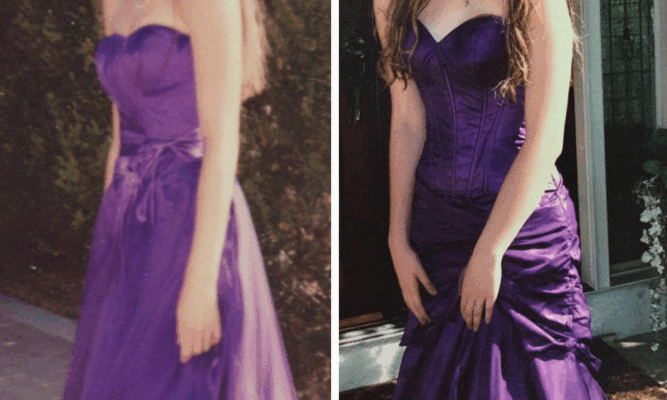
It was lavender satin with embroidered flowers on the bodice and delicate spaghetti straps that caught the light. The pictures of her in it looked like something out of a late-’90s teen magazine—soft curls, glossy lips, a smile that seemed to light up the room. When I was little I’d climb into her lap and trace those photos in her scrapbook.
“Mom,” I’d whisper, “when I go to prom, I’ll wear your dress too.”
She’d laugh—not loudly, but the way her eyes softened and her fingers smoothed the fabric like it was something precious. “Then we’ll keep it safe until then,” she’d say.
But life doesn’t always keep promises.
Cancer took her when I was twelve. One month she was tucking me into bed; the next, she was too weak to stand. After the funeral, the dress became my anchor. I tucked it into its garment bag and hid it at the back of my closet. On long, quiet nights I’d unzip it just enough to touch the satin and feel like she was still there. The dress wasn’t fabric to me—it was her voice, her scent, the way she sang badly while making pancakes. Wearing it to prom wasn’t about fashion. It was about holding onto her.
Then came Stephanie.
Dad remarried when I was thirteen. Stephanie moved in with white leather furniture, expensive heels, and a knack for calling everything “tacky” or “outdated.” My mom’s ceramic angels vanished from the mantel in the first week. The family photo wall came down next. One day I came home from school to find the oak dining table—where we’d carved pumpkins and eaten holiday meals—on the curb.
“Refreshing the space,” Stephanie chirped as she tossed a new throw pillow on a sleek couch. Dad told me to be patient. “She’s trying to make it feel like home,” he said. But the house felt less like ours and more like hers.
When she finally saw the dress, she wrinkled her nose like I’d handed her something unpleasant. It was the day before graduation, and I was twirling in front of the mirror.
“Megan, you can’t be serious,” she said, clutching a wine glass. “You’re going to wear that to prom?”
“It was my mom’s,” I said, fingers tight on the garment bag. “I’ve always dreamed of wearing it.”
Her smile disappeared. “Megan, that dress is decades old. You’ll look like —” She gestured as if to say “from a thrift store.” “You’ll disgrace our family. You’re part of my family now, and I won’t have people thinking we can’t dress our daughter properly.”
“I’m not your daughter,” I snapped before I could stop myself.
She clenched her jaw. “Maybe if you acted like one, we wouldn’t have these problems. You’ll wear the designer dress I picked out. It cost thousands.”
“This is special to me,” I said. “I’m wearing it.”
“Your mom’s gone, Megan. I’m your mother now. You’ll do as I say.” Her words were about appearances—about image, which was her religion.
I cried that night with the dress clutched to my chest. I decided I would wear it no matter what.
Dad said he had to work a double shift the day of prom. “I’ll be back by the time you return,” he promised, kissing my forehead. “I want to see my girl looking like a princess in her mother’s dress.” We’d both talked about it before; he knew which dress I meant. I promised him I’d make him proud.
The next afternoon, butterflies and make-up and hair done exactly how Mom used to do it, I climbed the stairs and unzipped the garment bag—and froze.
Satin ripped down the seam. The bodice was stained with something dark and sticky, like coffee. The embroidered flowers were smudged with black ink. I sank to my knees, clutching the ruined fabric.
“Oh. You found it.” Stephanie stood in the doorway, syrupy sweet and smug. “I warned you not to be so stubborn.”
“You… did this?” I managed.
“I couldn’t let you embarrass us,” she said. “That rag is outdated. I bought you a new designer gown. Wear that.”
“It’s all I have left of her,” I whispered.
She stepped closer until she loomed over me. “You’ll stop playing pretend. You’ll wear what I choose.”
Her words landed like slaps. She left with her shoes clicking down the hall.
Then Grandma came in. My mother’s mother had let herself in when no one answered. She rushed upstairs and found me with the dress. When she saw the damage, something hard and fierce lit her face.
“Get a sewing kit. And peroxide,” she said. “We’re not letting that woman win.”
Downstairs, Stephanie kept her distance—she had always been cowed by Grandma’s stare. For two hours Grandma scrubbed stains with lemon juice and peroxide and stitched the seam with hands that trembled but didn’t stop. I sat beside her, handing tools and whispering encouragement. When she held it up, it looked like a miracle.
“Try it on, sweetheart,” she said.
The repaired seam was a little stiff; the dress fit tighter across the bust. But when I slipped it on, it was beautiful. It was still my mom’s. Grandma kissed my forehead. “Now go. Shine for both of us. Your mom will be right there with you.”
At prom, people gasped. The lavender caught the lights and moved like memory. “You look incredible,” a friend breathed.
“It was my mom’s,” I told her softly. I danced and laughed and let myself be seventeen.
I came home before midnight. Dad was in the hallway in his work uniform—tired and proud. When he saw me he froze.
“Megan… you look beautiful,” he said, voice thick. “You look just like your mom did that night.” He hugged me, and I let myself cry happy tears.
Stephanie appeared at the end of the hall, eyes narrow. “So this is it? You let her embarrass us in that cheap rag? James, people probably laughed behind her back.”
Dad turned, his arm tightening around me. His voice was calm and steady. “No, Stephanie. She looked radiant tonight. She honored her mother, and I’m proud of her.”
“You’re choosing her over me?” she spat.
“Every time,” he said.
She went pale, grabbed her purse, and stormed out, slamming the door. “Fine. Stay in your little bubble of grief. I won’t be part of it.”
Grandma—who’d told Dad what happened—stayed until late and brought muffins the next morning. For the first peaceful breakfast in years, the three of us—Dad, Grandma, and I—sat around the table and smiled.
That night I hung the lavender dress back in my closet. The seam was mended; the stains were lighter, but the dress held its history in the worn places and in the careful stitches.
It wasn’t just fabric. It was proof that love had endured. Just like me.