They said no maid ever lasted in that house — not one.
Behind the tall black gates and the roses that bloomed year-round, the Richards mansion looked like a dream. Inside, it was a battlefield. Outsiders saw chandeliers and fountains; the staff heard slammed doors, sharp words, and quiet crying. At the center of it all was Madame Rose Richards — young, beautiful, and merciless.
In six months nine maids had fled. Some left in tears, some trembling; one jumped the fence barefoot to get away.
Then Naomi Okafor arrived. In her early thirties, quiet, carrying only a nylon bag and a mother’s fierce determination, she took the job because she had no choice. Her daughter Deborah, nine years old, lay in a hospital bed with a failing heart. Naomi needed this paycheck to pay for treatment.
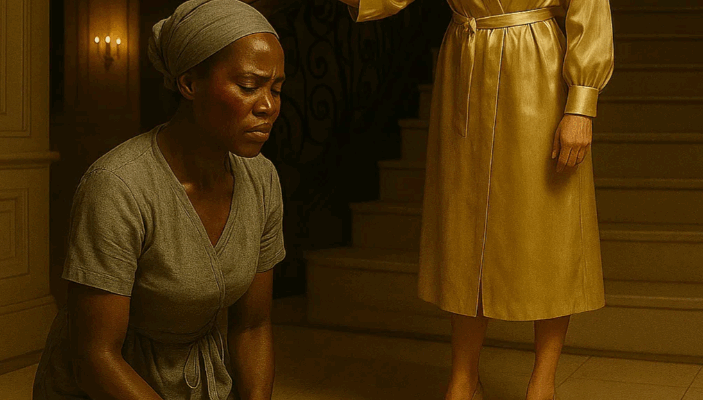
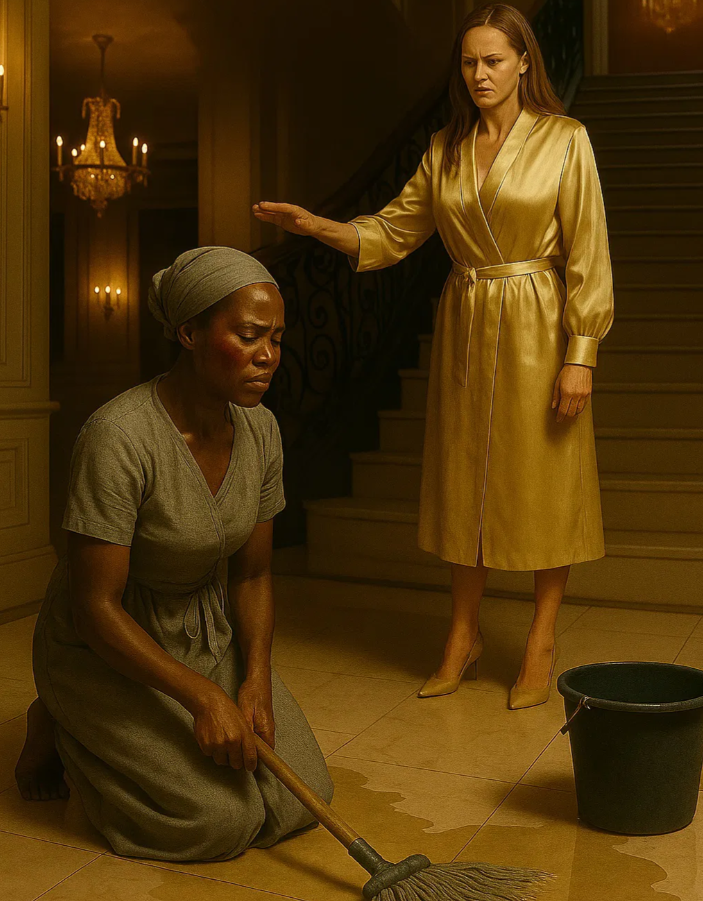
On her first morning Naomi tied a scarf over her hair and began mopping the marble floor. The house was still until the sharp click of heels on the stairs. Madame Rose descended in silk and without a word tipped Naomi’s bucket across the floor. Water soaked Naomi’s shoes.
“This is the third time someone blocks my way,” Rose said coldly. “Clean it again.”
Naomi swallowed her pride, bent, and started over. From the hallway another servant muttered, “She won’t last.”
Naomi’s pride had been left in hospital corridors, pleading with doctors to save her child. She wasn’t soft — she was steel wrapped in silence.
Next day Naomi rose before dawn. She swept the driveway, polished glass doors, dusted carved tables. In the kitchen she worked beside Mama Ronke, the family cook, when Rose demanded lemon water. Naomi sliced, balanced the tray, and carried it upstairs. Rose sipped, smirked, and said, “You’re lucky. You got it right.”
Then Rose noticed a tiny stain. Naomi cleaned it at once; in the hurry she nearly knocked over a perfume bottle but steadied it. Rose slapped her. “You’re clumsy.”
Naomi bowed her head. “I’m sorry, Ma.”
Unseen, Mr. Femi Richards watched from the hallway. His gray eyes softened, but he said nothing.
Naomi had vowed not to run — not while Deborah needed her.
By the third day the staff were watching with curiosity. Naomi hadn’t cried, hadn’t raised her voice, hadn’t left. She worked steady as a river. Rose tried harder: Naomi’s maid uniform vanished, leaving her in a wrapper and a faded T-shirt. Rose mocked her in front of everyone.
“Did you sleep in the gutter, or are you matching the mop?” she sneered.
Naomi lowered her head and went back to work.
Then came “accidents.” Rose spilled red wine on a white rug and watched as Naomi knelt to scrub. She smashed a crystal bowl and blamed Naomi. Naomi whispered, “I’ll clean it, Ma,” and did.
No one had held on this long.
One rainy morning Naomi passed a hallway mirror and froze. Rose sat reflected in the glass — barefoot on marble, mascara streaked, her silk scarf slipping. She looked less like a queen and more like someone broken.
Naomi hesitated, then folded a towel and placed it beside Rose before turning to leave.
“Wait,” Rose whispered, voice cracking. “Why do you stay?”
Naomi turned, calm and steady. “Because I have to. My daughter is sick, and this job pays for her treatment.”
Rose’s lips trembled. “You’re not afraid of me?”
Naomi shook her head. “I used to be afraid of life. But when you sit in a hospital holding your child’s hand, nothing else can break you.”
For the first time Rose was silent. She no longer saw a servant — she saw a woman bearing scars as heavy as her own.
After that, the house changed. Doors stopped slamming. Orders softened. Rose even murmured “thank you” when Naomi served tea. The staff whispered, astonished: “The madam has changed.”
One Sunday Rose handed Naomi a white envelope. Inside was cash and a note: For transport. Go see your daughter.
Naomi rushed to the hospital. Deborah smiled weakly. “Mommy, you came,” she said. Naomi promised, “Very soon, my love. Hold on.”
Rose had sent her driver to follow. When she learned the truth of Deborah’s illness, something in her shifted. For the first time in years, Rose wept.
Days later she insisted Naomi attend a women’s luncheon. Naomi protested, but Rose had already chosen a peach gown and scarf. At the event Rose introduced Naomi not as a maid but as “a strong woman, a mother.” A doctor who ran a children’s heart foundation asked about Deborah.
A week later Naomi received a call: the foundation would sponsor the surgeries in full — bills, medication, aftercare. Naomi collapsed to her knees in the kitchen, weeping. The staff gathered around her, sharing the joy.
The operation succeeded. Deborah lived.
When Naomi brought her daughter home, the household held a small feast beneath the mango tree — jollof rice, puff-puff, balloons swaying in the breeze. Rose knelt before Deborah, handed her a storybook, and whispered, “Call me Auntie Rose.”
That day Naomi was promoted to Head of Household Operations, given better pay, her own quarters, and full medical support for Deborah.
“You did what no one else could,” Rose said simply. “You didn’t just clean this house — you cleaned the fear out of it.”
From then on Naomi was more than a maid. She became the heart of the Richards mansion. Femi thanked her for bringing peace back. The staff respected her. Rose — once called “Madame Ice” — treated her like a sister.
Sometimes at night Rose confessed her past. “I was once a maid, too,” she admitted. “Humiliated, dismissed. I swore I’d never be weak again. You showed me strength isn’t cruelty — it’s patience.”
Naomi would smile softly. “Sometimes God takes us through fire, not to burn us, but to make us light for others.”
The mansion that once echoed with insults and slammed doors now rang with laughter and life.
Naomi arrived with nothing but a nylon bag and a mother’s desperation. By standing firm she changed everything. She didn’t win by shouting — she won by enduring. In doing so she healed not just her daughter, but a whole house.
Note: This story is inspired by real events but has been fictionalized. Names and details have been changed to protect privacy and enhance the narrative.