
Ricardo Mendoza’s name once ran in bold across the business pages. At forty-two he was a construction titan: skyline-etching towers, a coastal mansion, private jets and a fleet of luxury cars. Assistants managed every minute of his life.
On paper he had everything. Behind the glass and marble, though, he felt a hollow that money couldn’t fill. There was one thing he had never replaced: Isabella.
Fifteen years earlier they had been inseparable. They met at college—he a driven business student, she an art student with a laugh that lit rooms. They married young, with nothing but hope. Isabella painted in their cramped apartment and left meals waiting on the table while Ricardo chased the next contract.
Bit by bit, ambition took him. Deadlines swallowed dinners. Contracts replaced conversations. When Isabella begged, “Ricardo, I don’t need wealth. I just need you,” he promised, “Just one more year, Bella.” That year became many. Her laughter dimmed and one night she left a single note: *I love you, but I can’t live in second place anymore.*
Ricardo promised himself he’d win her back after one more deal. By the time he looked up, she’d vanished—new number, unknown address.
Years later, success had multiplied, but so had his regrets. Relationships were shallow, smiles transactional. Then, on a rainy Thursday, fate led him into a small neighborhood restaurant—wooden tables, the smell of baked bread, ordinary warmth that made his city restaurants feel like stage sets.
He sat and scanned the menu, then froze.
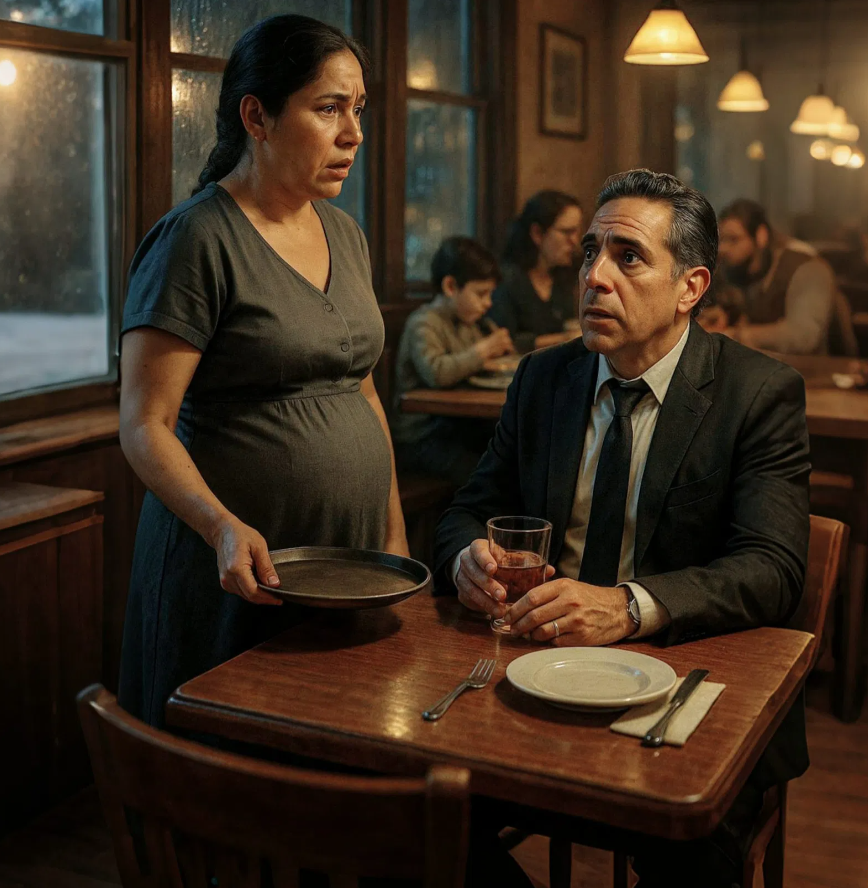
Isabella moved through the dining room with a tray, hair in a simple braid, plain uniform, a tired smile. Beneath her apron a gentle curve showed—she was pregnant. A wedding ring glittered on her left hand, but it wasn’t his.
When her eyes met his, the restaurant blurred. Her tray trembled; she steadied it and wore the polite calm of a server.
“Good evening, sir. Would you like to hear the specials?”
“Bella…” he whispered.
She hesitated a fraction, then guarded her voice. “I’m sorry, sir. Have we—have we met?”
The words cut him clean. He ordered simply just to keep her near. She worked the room while avoiding his gaze; he watched her move. When she refilled his glass, he leaned forward. “I know you. I’ll never forget you.”
Her hand shook. “Please,” she said, almost a plea. “Don’t make this harder.”
He lingered after paying. As the crowd thinned she approached, low and wary. “Ricardo, why are you here?”
“Because fate put me here,” he said. “I thought I’d lost you forever.”
“You did,” she said. “You chose your empire over us. That chapter is closed.”
He looked at her belly. “You’re expecting.”
She placed a hand protectively there. “Yes. And I’m happy. Please, let me be.”
He left that night with a heavier heart than his bank account could measure—and with the stubbornness to try again. The next day he returned. And the next. For a week he sat at the same table, watching, tipping generously, never pressing. Finally, after closing, she sat with him.
“This can’t go on,” she said. “Why are you doing this?”
“Because I need to know,” he answered. “Are you truly happy, or just surviving?”
Her composure broke. “After I left, I tried to rebuild. I met someone kind. We married… he passed away last year. This child is his.”
Relief and sorrow knotted in Ricardo’s chest. She hadn’t been stolen by another man now, but she carried another man’s memory.
“I’m sorry,” he said. “I should have been there. I should never have let you go.”
“You can’t change the past,” she told him.
“No,” he said quietly. “But maybe I can change the future.”
Ricardo didn’t show up as a magnate. He showed up as a man willing to earn back trust. He carried trays when her back ached, drove her home in storms, fixed leaky faucets with his hands in sleeves rolled up instead of a tailored suit. Small, steady acts chipped at the armor she had built.
One night under a streetlamp she said, “You’ve changed.”
He smiled, careful. “I’ve remembered what mattered.”
“And if your empire calls?”
He took her hand as though it were the only thing he couldn’t afford to lose. “Then I walk away from the empire. I’d trade every skyscraper for having you beside me.”
Months passed differently this time. He attended doctor’s appointments, painted the nursery, learned lullabies. When Isabella went into labor he stood in the delivery room with tears streaking his face. The baby was not his by blood, but when he cradled the newborn girl, something inside him felt complete.
“I’ll never let you or your mother feel alone again,” he whispered to the child.
Isabella, exhausted and smiling, replied, “Welcome home, Ricardo.”
Ricardo Mendoza still graced magazine covers, but the image had changed: a magnate with a baby in his arms, a woman at his side, a softness in his eyes. He remained wealthy by any measure, but his richest possession had become bedtime stories, warm dinners at a small neighborhood restaurant, and the laughter he had once nearly lost.
The empire was impressive. The family he rebuilt was his masterpiece.
*This story is inspired by real emotions and events but has been fictionalized. Names and details were changed to protect privacy.*