A dreary, rain-soaked morning changed nine-year-old Laura’s life forever.
Clutching her mother Lucy’s hand, she watched the front door of their modest apartment close for the last time. Their furniture, clothes and toys were piled on the curb—everything left after an eviction for unpaid rent.
Lucy, who had struggled with alcoholism for years, tried to stay strong for Laura, but the sorrow in her eyes was unmistakable. Once a hopeful hairdresser who dreamed of opening her own salon, she’d been beaten down by grief and bad luck.
Two years earlier, Laura’s father, David—a hardworking, kind man—died suddenly of a heart attack. His loss unraveled them. Grief swallowed Lucy; alcohol became an escape. Jobs slipped away, bills accumulated, and friends drifted off.
Now they were homeless.
That same gray afternoon, mother and daughter drifted through the city with nowhere to go but the streets. They spent nights under overpasses, on bus-station benches, or, when fate allowed, in a crowded shelter downtown.
Lucy began attending AA meetings and found a part-time cleaning job at a church. It didn’t pay much, but it kept her sober. Laura, wise beyond her years, never complained. She gathered recyclables, guarded their few bags while Lucy worked, and kept a steady, brave smile even when hunger pinched her ribs. She was a small light in a bleak place.
One cold Thursday morning, after a night beneath an abandoned billboard near the old train depot, they headed to St. Mark’s Church for breakfast. The drizzle had returned and Laura hugged her coat tighter. Passing a bank of trash bins behind a gleaming glass building, something caught her eye: a leather wallet half-buried in wet leaves.
“Mom,” she whispered, tugging at Lucy’s sleeve. “Look.”
Lucy frowned. “It’s probably empty.”
Laura picked it up. The wallet was thick with bills—hundreds, maybe thousands. Credit cards. A driver’s license. And a silver business card: Gregory H. Turner, Attorney at Law, Turner & Associates.
Lucy stiffened. “Put it back.”
“But Mom—there’s so much—”
“No. It’s not ours. We’ll return it.”
Laura hesitated, then nodded. Deep down she knew her mother was right.
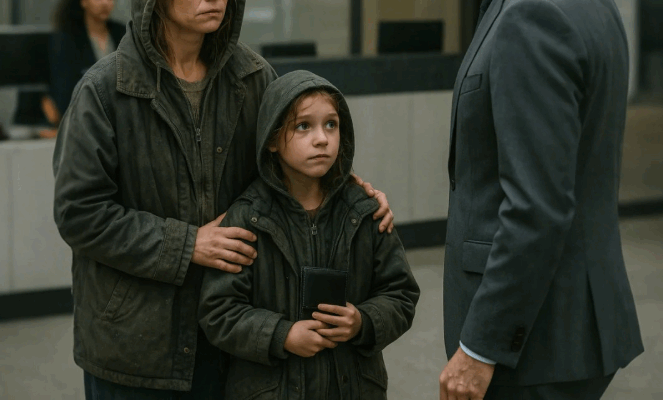
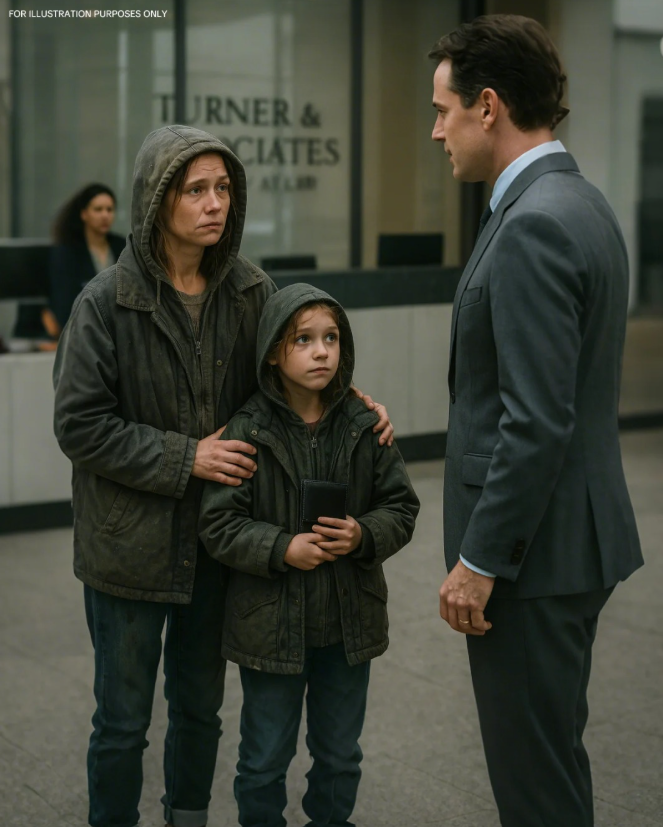
Turner & Associates was only three blocks away: a modern, intimidating building. Soaked and shivering, they were an odd sight in the polished lobby. Lucy set the wallet on the reception counter.
“We found this,” she said. “It belongs to Mr. Turner.”
The receptionist checked the name and disappeared behind a frosted door. A few minutes later a tall man in a gray suit emerged.
“I’m Gregory Turner. You found my wallet?” he asked.
Laura nodded and handed it over. He opened it, counted the bills—everything intact.
“Most people wouldn’t have returned this,” he said.
“We needed it,” Laura replied honestly, “but it didn’t feel right.”
Something in his expression softened. “Wait here.”
He came back with two warm pastries and two cups of cocoa and handed them over without a word. “You haven’t eaten, have you?”
That small kindness was only the beginning.
A week later he invited them to lunch, listened without pity, and said, “I want to help.”
Lucy protested. “We’re not asking for charity.”
“You’re not,” he replied. “But Laura gave me back something precious: trust. I’d like to return the favor.”
Over the following days he made calls and set meetings. One bright Tuesday morning he stood with Lucy and Laura in a crowded family courtroom.
“This is Family Court,” he told them. “I filed for emergency housing assistance. We’re going to get you somewhere safe.”
The judge read the file Gregory had submitted. “Miss Andrews, it says you’ve been sober for over ten months?”
Lucy nodded. “Yes, Your Honor.”
“And your daughter is enrolled in school?”
“We had to withdraw her when we lost our apartment, but she loves to learn,” Lucy answered.
Gregory turned to the judge. “I’ll vouch for them.”
The judge smiled. “Motion granted. Temporary housing for 90 days, renewable on review. Let’s give this family a fair chance.”
Lucy wept. Laura squeezed her hand.
The apartment wasn’t big, but to Laura it felt like a palace: a real kitchen, warm running water, two beds. Gregory brought over a secondhand bookshelf and filled it with books. Laura read for hours—fairy tales, mysteries, poems.
Gregory continued to visit, always thoughtful: apples, crayons, a pair of gloves. He never patronized them; he treated them like people. He helped Lucy enroll in a job-training program, found a grief counselor, and when he learned Laura hadn’t been in school for nearly a year, he arranged and offered to sponsor her tuition at a private elementary school.
“She’s got a spark,” he said. “We should give it every chance.”
Laura thrived—acing spelling bees, writing stories, making friends. One afternoon she came home waving a flyer: career day at school.
“What will you be?” Gregory asked.
“A lawyer,” she said, beaming. “Like you.”
“Will you want me to come?” he asked.
“You believed in us,” she replied. “You changed our life.”
“I wouldn’t miss it,” he said.
Years passed. Lucy retrained, became a certified beautician, and opened a modest, affordable salon she named New Leaf. Gregory was her first customer. He remained present—at birthdays, spelling bees, holiday dinners—never imposing, always steady.
On graduation day, Laura stood onstage as valedictorian. She looked out at the crowd and then at Gregory.
“There was a time when my mom and I had nothing but each other,” she began. “We slept on benches and ate at soup kitchens. I was a scared kid. One day I found a wallet behind a trash can. Returning it started everything.”
She met Gregory’s eye. “Mr. Turner didn’t just help us. He gave us dignity, books, a warm home, school, and most of all, time—to heal and to grow.”
The auditorium erupted in applause. Lucy wept in the front row.
A year later, at seventeen, Laura sat beside Gregory in a courtroom as he argued passionately for a young woman facing eviction. Afterward he turned to her.
“What did you think?” he asked.
“I want to do this forever,” she said. “Help people. Like you do.”
“You will be amazing,” he told her.
That lost wallet—once returned—had been more than cash and cards. It became a turning point: a single honest act that rippled through two lives and changed them forever. It began with a child’s simple decision to do what was right.
This piece is inspired by stories from everyday readers and written by a professional writer. Any resemblance to actual names or locations is purely coincidental.