It was one of those gray afternoons when winter refused to let go. My son Liam and I were leaving the grocery store, juggling bags and shivering against the wind. Since my husband died, the year had been hard—grief hung over me, and single parenting felt like a constant, exhausting slog. Some days I moved through the world on autopilot.
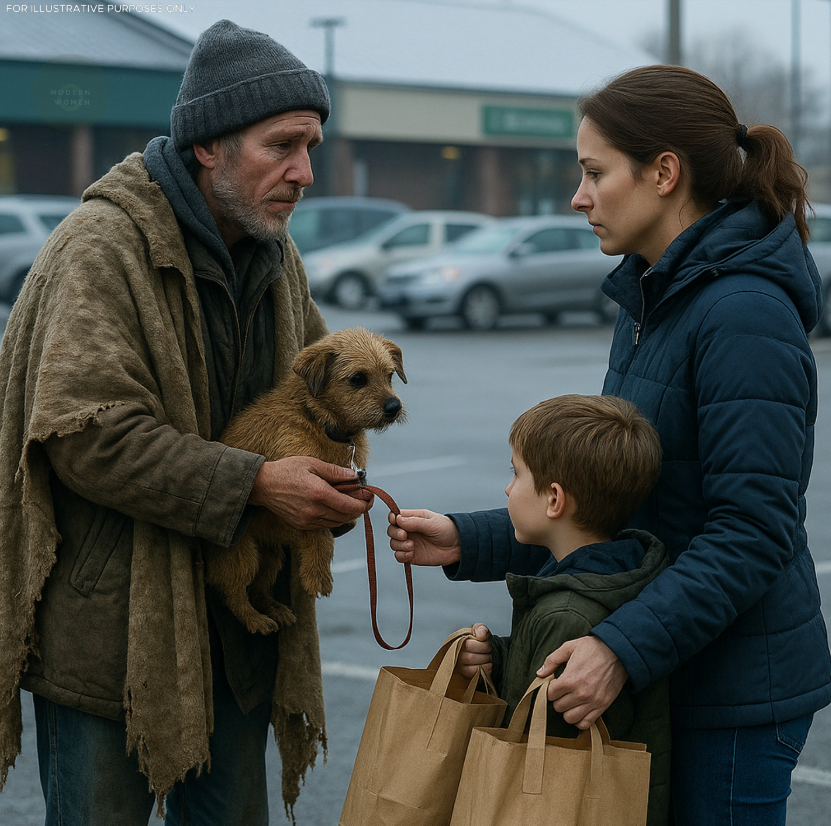
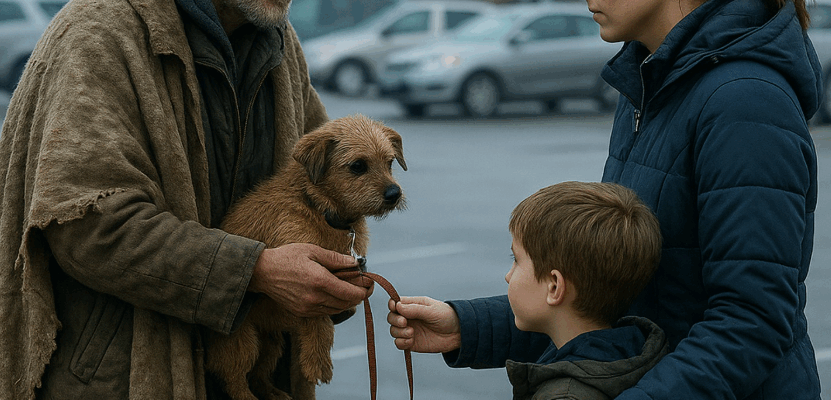
As I closed the trunk, I noticed a figure at the edge of the parking lot: a man wrapped in a threadbare blanket, hunched against the cold. His cheeks were raw from the wind, his eyes hollow with fatigue. At his feet sat a small, scruffy dog, shivering and leaning into him. He kept one hand protectively on her back, and something in that gesture stopped me.
The man rose and walked toward us. My heart tightened—I didn’t know what he wanted. His voice was rough but gentle when he spoke.
“Ma’am,” he said, looking down. “I’m sorry to bother you, but…would you take my dog?”
For a second I thought I’d misheard him. “Excuse me?”
He swallowed. “Her name’s Daisy. I love her more than anything, but I can’t take care of her anymore. She’s cold all the time. I don’t have enough to feed her. She deserves better.”
My first instinct was to refuse. I had enough on my plate—work, bills, keeping Liam safe. But then I felt a small tug on my coat. “Mom,” Liam breathed, his wide brown eyes shining. “Please. She needs us.”
That was all it took. I watched how Liam looked at Daisy, how the dog’s tail gave a hopeful, weak wag. “All right,” I said quietly.
Relief washed over the man. He knelt, kissed Daisy’s head, whispered something to her, then trembled as he handed her leash over. “Be good, girl. You’re going to be loved.” Without another word, he pulled the blanket tighter and walked back into the shadows.
That evening, Liam insisted on bathing Daisy. He wrapped her in his favorite blue blanket and tucked her into his bed. She licked his cheek and gave him a grin that made his face light up—one of those smiles I hadn’t seen in months.
Something in the house changed that night. For the first time since my husband’s death, warmth returned—not just from the dog’s small body but from a softness in the rooms where silence used to live. Daisy settled into our lives easily. She followed Liam everywhere, rested her chin on my lap while I worked late, and filled the empty corners with small, ordinary kindness.
I thought of the man often. Where was he sleeping? Was he warm? Did he miss Daisy the way she sometimes looked for him at night? Then, a month later, a strange envelope arrived with no stamp and no return address. Three words were written on the front in neat handwriting:
From your old friend.
Inside was a folded sheet, a letter addressed not to me but to Daisy.
“My sweet girl,
If you’re reading this, you’re safe and loved. I didn’t give you up because I stopped loving you—I gave you up because I loved you too much to watch you suffer with me.
When I found you by the tracks as a tiny pup, I promised I’d never let you be alone. You saved me more times than I can count. You gave me joy when life was dark, warmth when nights were cold, and love when I thought I didn’t deserve it.
I couldn’t keep my promise forever. Forgive me. I’ll never forget you.
With love,
Your Old Friend.”
I sat at the kitchen table with tears on my face. Liam read over my shoulder and whispered, “It’s from Daisy’s first dad.” We held Daisy that night, and though she couldn’t understand the words, she felt the emotion and wagged contentedly.
After that, I couldn’t stop looking for him. I asked neighbors, checked around the grocery store where I’d first seen him, and drove around parks and shelters hoping for a glimpse of that familiar blanket. Weeks went by with nothing.
Then one Saturday at the park, as Daisy raced after Liam’s ball, I saw him: the same man, but on a bench with a donated coat. The blanket was gone, his beard neater, his eyes less hollow. He looked different—still tired, but steadier.
Daisy saw him, froze, then sprinted into his lap. He wrapped his arms around her, crying softly. “Hey, girl,” he whispered. “I missed you.”
We sat together on that bench—Daisy between us—while he told us his name was Robert. He’d once had a job, a home, a family; after losing his parents, then his work and health, he’d fallen into homelessness. Daisy had been his lifeline. “She kept me alive when I didn’t want to go on,” he said.
I told him about losing my husband and how hard it had been to keep everything together for Liam. For the first time in a long while, I felt understood. Robert thanked me for taking Daisy in; he said, softly, “I think she’s saving you, too.”
He got a donated phone and we exchanged numbers. Robert visited often—bringing treats, walking Daisy with Liam, sometimes staying for dinner. He shared stories that made Liam listen with wide eyes. Slowly, Robert connected with a program that helped him find housing and work. He rebuilt himself piece by piece.
Looking back, I see Daisy as more than a rescued dog. She became the bridge between broken people: a boy learning compassion, a mother finding new hope, a man finding his way back. That letter—written with equal parts grief and love—wasn’t a final goodbye. It was the start of something else.
Now, when I see Daisy curled at Liam’s feet or trotting happily toward Robert, I know the story wasn’t only about loss. It was about second chances—for all of us.