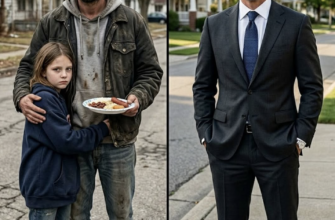
For months Rachel counted every penny and collected every favor, determined to give her daughter Emma a birthday to remember. She never expected the party planned down the block to fall apart — forcing guests into their little backyard, festooned with handmade streamers, thrifted wreaths, and something money couldn’t buy: pure joy.

I knew something was wrong when Emma stopped asking for glitter.
Usually, as autumn arrived, she threw herself into party planning: guest names scribbled on scraps, balloon-arch sketches in notebook margins, and taped “reserved” signs on the chairs for her self-appointed “planning squad.” That breathless energy defined her.
At first I blamed last year, when I’d canceled her party because an extra shift at the restaurant made me miss it. But Emma just smiled and said, “It’s fine, Mom. Next year will be even better.” As the date approached, she hardly mentioned it at all.
So I took matters into my own hands. I tucked away coins, picked up odd jobs, skipped my morning coffee, even sold the earrings Grandma had given me when Emma was born. I imagined the look on her face at the garlands, the cupcakes, the sound of friends laughing in our small yard.
It would be modest. But it would be hers.
Then Laurel appeared. Her daughter Harper shared Emma’s birthday. Laurel always looked as if she’d walked out of a lifestyle ad — linen dresses, flawless hair, an SUV that hinted at a comfortable life. I’d seen her hand out extravagantly packaged goody bags: custom tags, layered tissue, the works.
I thought a joint party might bring our families together. Two moms, one plan. I texted her:
“Hi Laurel — Harper and Emma share a birthday. Want to do a joint party? We could split the costs and planning. Excited to hear your thoughts.” — Rachel
Silence. Hours passed. Then, after the school run the next morning, she replied:
“Hi Rachel, thanks but we’ve arranged something more refined for Harper. Our guest list and theme don’t align. I wish Emma a beautiful day.”
That word — “refined” — landed like a blade: polite, but deliberately cutting. I hadn’t felt dismissed like that since Emma’s father said he wasn’t coming back.
Still, I pressed on. On the morning of the party I rose before dawn to hang balloons. Nana Bea arrived, balancing a folding table on her car roof; slippers on, curlers still in her hair, she had the determined softness of a grandmother who never stopped helping.
“You need rest more than glitter,” she said, eyeing the cupcakes.
“I’ll rest tomorrow,” I laughed too loudly.
When I showed her Laurel’s text, she hardened. “‘Refined,’ huh? The only thing refined about that woman is her vanity.”
“I just want Emma to be surrounded by friends,” I muttered. Meanwhile, Laurel’s celebration promised a DJ, a professional baker, and an influencer to film it.
Nana cupped my face. “Your party has love. Pure love. Let them keep their sparkle. We have heart.”
So we decorated: paper garlands made by Emma, a patched lemonade dispenser, cupcakes shaped like an eight, and edible glitter that floated with every laugh. Emma wore a rainbow tulle skirt I stitched from scraps; her sneakers sparkled with each spin. “Welcome to my party!” she cried into the karaoke mic, every inch the star.
I prayed it would be enough. By 2:30 I sat on the steps and watched the empty street. By 3:00 we offered another slice of pizza. At 3:15 Emma slipped away to the bathroom. When she came back, her crown and smile were gone. The silence settled heavy where laughter should have been.
Then, at 3:40, a knock. Three children stood at the gate in glittery outfits, balloons bobbing. Parents lingered outside, then let them in. Minutes later, the backyard lit up with energy.
Harper’s party, I learned, had imploded: a tantrum over a rigged contest, a spilled cake, a magician’s trick gone wrong, a stolen crown. “It ended early,” one mother admitted. “My son begged to come here, so we came.”
Neighbors streamed in — some clutching hurriedly wrapped presents, others drawn simply by the sound of fun. I watched Laurel’s car drive by; she dropped off a child, exchanged a look, and sped away. Emma didn’t notice. She was dancing statues with Nana Bea, cupcakes disappearing, a group singing “I Am Free” so off-key that everyone laughed until they cried.
“Mom, they came!” she shouted, breathless. I held her and let my face press into her wild curls. “Yes, darling, they came.”
That night, with the last of the glitter swept away and Nana humming “Happy Birthday” as she left, I typed a message to Laurel:
“Thanks for bringing the kids. Emma’s party was wonderful. I hope Harper’s was too.”
No reply — and perhaps that was for the best.
A week later Emma handed me a crumpled drawing: stick figures, cupcakes, a crooked garland labeled “Emma’s Party.” In the corner, a figure smiling in red pencil. “Harper?” I asked.
Emma shrugged. “She said her party wasn’t fun. She wished she’d come here. So I gave her the unicorn piñata we forgot. She didn’t have one.”
“Is she your friend?” I asked.
“Yes,” Emma said simply. “Friends share.”
True joy, I realized, isn’t measured by sparkle or price. It glows from sincerity — from effort, from love, from the people who show up. Laurel was right about one thing: our parties weren’t the same. Hers was refined. Ours was authentic. And authenticity — that messy, heartfelt kind — was priceless.