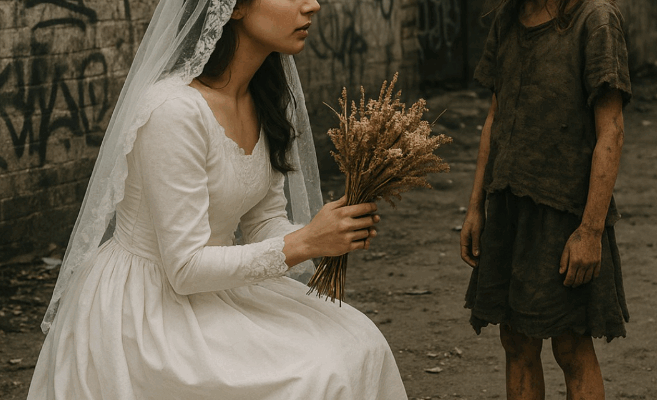
“I wouldn’t marry a man like that!”
The words struck like a bell against glass—clear, impossible to ignore. My hand froze on the restaurant door, fingers pressed into the satin of my dress. The night smelled faintly of rain and roses; for a single heartbeat the city seemed to hold its breath with me.
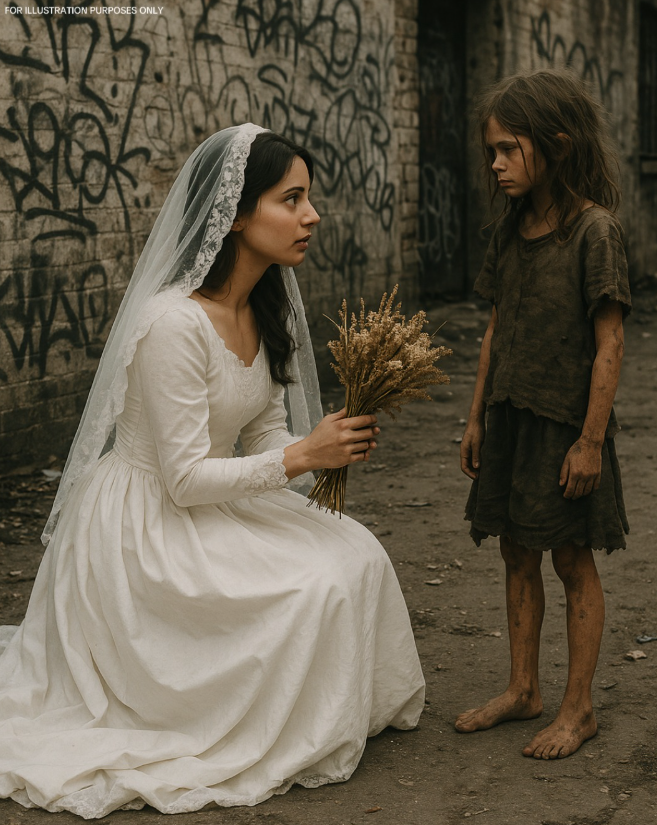
I turned and saw her: a little girl, braid long and fair, wearing a jacket two sizes too big. Her shoes were scuffed, and her eyes—those eyes—held a knowledge no six-year-old should.
“What did you say?” I asked, softening my voice as my veil lifted in the breeze.
“I wouldn’t marry a man like that,” she repeated, steady as a lighthouse. “He’s mean. I saw him yesterday. He pushed my mom.”
Music spilled from inside—piano keys, the clink of glasses, a photographer calling for the best man. Ethan, my groom, waited among those currents of light and champagne. But the girl’s words pulled me out of the river and onto the bank, dripping and stunned.
“What’s your name?” I asked.
“Polly,” she said. “Mom says Pauline, but I like Polly.”
Her braid swung when she spoke, earnest and unafraid.
“What’s his name? The man you saw?” I asked, though I already knew.
“Ethan,” she answered. “He used to come to our place. Yesterday he yelled. Mom cried after.”
Something brittle inside me cracked, but I held it. “Can you show me where you live?” I asked quietly.
Polly hesitated, then nodded. “It’s close.”
I looked once at the bright restaurant, then at Polly. Satin gathered in my fist as I lifted my skirt. “Okay,” I said. “Let’s take a short walk.”
We went two blocks beneath twinkle lights and a mural of painted birds, past a florist’s buckets of soft peonies, into a small courtyard off Cedar Street. Laundry hung like flags. A rusty blue slide watched over a square of grass.
Polly unlocked a door with a brass key that looked too heavy for her hand.
Up a creaking staircase, down a narrow hall, into a warm apartment that smelled of tea and laundry soap. A young woman rose from the carpet by the radiator, a notebook clutched to her chest. She had quiet brown eyes and the tired grace of someone who still knows how to stand tall.
“Mom, this is… the bride,” Polly announced, as if introducing a character from a storybook.
The woman blinked at my dress. “Oh.” She steadied herself. “I’m Anna. I—can I help you?”
“I’m Marina,” I said. “I was supposed to marry Ethan tonight.”
Her face shifted like weather. She folded Polly into her arms. “He didn’t tell me there was a wedding,” she said softly.
“Polly said he was here yesterday,” I continued. “She said you were upset.”
Anna’s fingers tightened on Polly. “He… wanted to talk. We dated. He promised to change. Then he didn’t like me working evenings, didn’t like ordinary things.” She smoothed a flyaway strand from Polly’s hair. “We’ve been apart for months. Yesterday he came by and I told him no. He got frustrated.” She inhaled, then let it go. “We’re okay,” she added, looking at me. “Polly was frightened, but we’re okay.”
You don’t always need many words to know the truth. I felt it humming beneath the surface, electric and undeniable.
“I’m sorry you went through that,” I said. “And I’m sorry I didn’t know.”
Anna’s face registered a small embarrassment, as if apologizing for weather beyond her control. Polly slipped her hand into mine—small, dry, certain.
“I didn’t want you to get sad like Mom,” she said simply.
“Thank you,” I whispered.
I stayed long enough to make sure they were safe, to write my number on a torn page of Anna’s notebook, to promise I’d be in touch. Then I lifted my skirt and walked back, the city lights shimmering as if underwater.
Inside, the hall became a kaleidoscope: gold, glass, smiling faces. My mother found me—anxious and relieved. “Where did you go?” she asked.
“I needed to check something,” I said, kissing her cheek.
Ethan threaded through guests, immaculate in his tux, that practiced smile warming every face it met. He took my hands. “Love,” he whispered theatrically, “everyone’s waiting.”
“Were you with Anna yesterday?” I asked. My voice was calm, but the question landed between us like the first raindrop.
He blinked. For a flicker I noticed a coolness behind his smile. “Anna?” he repeated, almost cheerfully. “Marina, what is this? On our wedding day?”
“Don’t,” I said. “Just answer.”
“I don’t know what you think you heard,” he said smoothly. “People talk. You can’t believe every—”
“I asked if you were with her,” I said.
“I stopped by to return a box of her things,” he answered. The words were neat, but the room tightened.
“And you raised your voice,” I said.
“People raise their voices,” he replied, quieter now.
A hush gathered. Eyes that pretended to look away were tuned to us. I didn’t want a spectacle. I wanted truth.
“There won’t be a wedding tonight,” I said softly.
For a moment sound continued in fragments—silverware set down, a distant laugh—then everything stilled like birds sensing a hawk. My father stepped forward but stopped when I shook my head. It felt necessary to stand in my dress and say it myself.
“I’m sorry,” I told our guests. “Thank you for coming. Please enjoy the food and music. The party can go on. It just won’t be a wedding.”
Ethan’s expression flickered from anger to persuasion. He reached for my elbow; I stepped back.
“Please don’t,” I said. “Not tonight. Maybe not ever.”
I slipped out before kindness could stop me. Outside, I watched a strand of veil catch moonlight and fall like a feather. It felt strange and quietly wonderful not to chase it.
The next morning was a hush after thunder. My phone brimmed with texts—questions, hearts, bewildered friends. I made coffee and wrote a list: Return rings. Cancel honeymoon. Call Anna.
I dialed before the second cup cooled. She answered on the third ring.
“It’s me,” I said.
“Are you all right?” she asked.
“I am,” I answered, surprised by the truth. “How are you and Polly?”
“We’re okay,” she said. “She’s coloring. She keeps drawing brides.”
“Tell her this bride is grateful,” I said. “I’d like to stop by.”
Polly showed me a portrait of three figures holding hands under a yellow sun: tall with a crown of scribbled flowers, medium with a brown ponytail, small with a long braid. “That’s you, that’s Mom, and that’s me,” she explained. “We’re at a park picnic. There’s lemonade.”
“I love lemonade,” I said solemnly. “And I love this drawing.”
We had tea at a small kitchen table with a sunflower cloth and talked practical things: schedules, safety, next steps. By that afternoon my father’s accounting friend had steered us to a lawyer. By evening we had a plan—documented boundaries, resources, safety measures. We didn’t make war; we made a plan.
In the weeks that followed I kept busy—the venue donated food to a shelter; my mother and I took the flowers to a rehab center. I mailed the rings back with a short, honest note: I hope we both learn from this. I used part of the honeymoon refund, with my parents’ blessing, to help Anna put a deposit on a brighter apartment where light pooled on the windowsills.
Anna found part-time work at the library, then a permanent post; her voice warmed in new ways on Wednesday story hour. Polly started first grade and announced she liked numbers “because they always tell the truth.” On Saturdays we made pancakes and argued toppings—lemon and sugar, blueberries, chocolate chips—Polly invariably settling the debate.
Ethan sent occasional polite messages, edges of apology but not enough to reopen that route. I kept replies short and kind. You can forgive without retracing the same path.
Spring came soft and confident. One afternoon after story hour we spread a blanket in Riverside Green under an old oak. Polly ran, plucking dandelion wishes and blowing seeds until the air glittered.
“I thought love would look like a wedding,” I told Anna, watching Polly make clocks spin. “Maybe someday it will. Right now it looks like… this.” I gestured at the thermos, the sky, the small girl laughing at a ladybug on her knee.
Anna tucked a strand of hair behind her ear. “I thought love had to look a certain way, too,” she said. “Maybe it looks like a door that stays open. Or a quiet Tuesday where nobody keeps score.”
Not everything was easy. On some days memories tugged at me—what-ifs and if-onlys. On those days Polly’s voice came to me: I wouldn’t marry a man like that. Not judgment—clarity. A child’s compass pointing north.
Clarity is a kind of love, I’ve learned. It tells truth without needing to punish. It closes softly so your hands are free to open something else.
By summer we had small traditions, stringing them like shells into a necklace. Thursdays we tried new recipes from a watercolor cookbook. Fridays we walked to the open-air cinema, a blanket big enough for two adults, one child, and a bag of popcorn that never survived the second act. Sundays, Polly taught me braids—my fingers clumsy, then surer, then trusted with special occasions.
One late July evening the building lost power and the hall filled with candle murmurs. We sat on the stoop with melting ice cream, trading stories with Mrs. Green, who mended wings for Peter Pan in a past life. When the lights came back, Polly sighed. “I almost liked the dark,” she said. “You can see other kinds of things.”
I used to imagine winter—dress, dance, a mailbox with our names. Now I live a summer that feels truer: a stoop that’s a front-row seat to neighborliness, a child leaning her head on my shoulder, a friend learning to laugh again.
I don’t know if this life is braver than the one I almost lived. I only know it’s truer, and truth makes room for joy.
One August morning Polly knocked gently and handed me a drawing: a house with a blue door and a heart for a doorknob; in the yard three figures held lemonades. Above them, in purple crayon, Polly had printed carefully:
We taped it by the spice rack—between cinnamon and vanilla—where it watched pancakes and quiet dinners and tiny conversations people forget to count. It was there the afternoon Anna came home with a lanyard and a grin: the library had offered her a permanent position. It was there the day a bouquet arrived with a note in neat handwriting: I’m glad you chose your own path. I’m choosing mine, too. —E. I set the flowers on the table and felt a last knot loosen, grateful for an ending that needed only a sincere wish.
Months have passed since I walked away from chandeliers and music into a night that had room for a voice like a bell. People ask for the story—over coffee, in quiet confessions. I tell them the truth: I loved someone. I wanted a life with him. A small voice reminded me that love without kindness is a pose in a mirror.
Walking away wasn’t failure; it was the soft beginning I almost didn’t hear. Not every closed door is slammed shut by anger; sometimes you close it gently because you’ll need both hands to open something else.
What opened for me was a kitchen with a drawing on the wall and the sound of crayons on paper; braids learned, blueberry pancakes discovered, laughter found again on a library carpet. Families can be grown like gardens—patiently, deliberately, with kindness for late-blooming days.
And always, under everything, that sentence rings like a lighthouse:
“I wouldn’t marry a man like that.”
Some may hear judgment in it. I hear love: for a mother, for a stranger in a white dress, for a world where girls learn young that “no” is a door you choose because the room beyond deserves your “yes.”
If I ever walk down an aisle again, it will be toward someone whose kindness shows up when nobody’s watching, who treasures ordinary Tuesdays, who doesn’t mind lemon sugar on pancakes and only fusses about braid symmetry if asked. Maybe that person will come. Maybe I’ll spend my life building other kinds of love—toward friends, a child who needed a steady hand and offered one back, toward the version of myself that finally believed she deserved gentle things.
Either way, the life I chose the night I listened to a small voice is the life I wake into with gratitude. When I tuck Polly’s blanket under her chin or watch Anna smile at a line in a book, I feel a joy that asks for no audience.
The world will always be loud with music and chandeliers and crystal laughter. Those things are beautiful. But somewhere outside, a small truth waits in the quiet, ready to turn our feet so that when we move again, we walk toward ourselves.
“I wouldn’t marry a man like that,” the little girl said.
And the woman I am now answers her every time: Neither would I.
*This story is inspired by real events but has been fictionalized. Names and details have been changed to protect privacy.*