The morning was gray except for the dull thud of two heavy suitcases on the garden path.
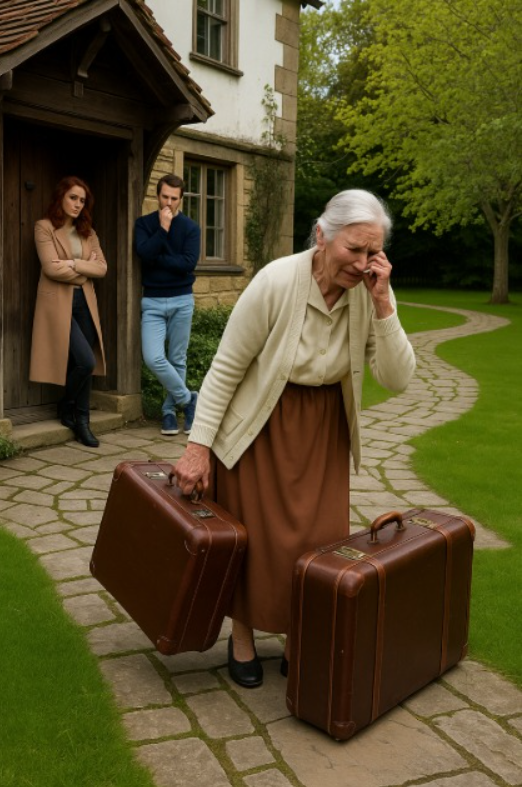
Seventy-six-year-old Margaret Walker stepped away from the stone house without a word. Her son Brian stood on the porch with his arms folded; his wife Lisa leaned against the doorframe.
“I’m sorry, Mom,” Brian said, voice flat. “We can’t keep taking care of you. It’s time you found a place of your own. You’ll be happier at the senior center.”
Margaret didn’t answer. She didn’t cry. Her hands trembled only slightly as she adjusted her grip on the worn leather handles. They had no idea what she carried—no idea that inside her bag, beside the everyday items, lay a secret.
She walked down the path without looking back. They didn’t deserve to see her face.
Three hours later she sat in a modest room at the local retirement facility: sterile but tidy, with beige curtains and a single bed. From the window she watched the garden she’d once tended and remembered grandchildren who had once called her “Nana” with bright, careless glee—back when Lisa hadn’t been whispering and Brian hadn’t been looking away. The distance between them had grown until it felt unbridgeable.
Margaret opened her handbag and produced a tiny key. It flashed in the light: the key to a safety deposit box. A box that held more than anyone would have guessed.
In 1983, Margaret’s late husband Henry had invested in a small company that made computer parts. Everyone thought it foolhardy, but Margaret had encouraged him. The company later merged with a tech giant. After Henry died, Margaret kept the shares—and quietly sold some during the boom. She’d never told Brian; she had not wanted money to change her family.
Over the years, the warmth of her son’s love cooled into resentment, then hardened further after his marriage. Still, she hadn’t spent the money—not from spite, but because she was waiting. For something. For someone.
Later that week, she met Isla, a volunteer in her early twenties who had a laugh like sunlight and an appetite for conversation. Isla served meals, lingered in the common room, and treated Margaret like a peer, not a task. One afternoon Isla noticed Margaret tracing a pinned map with her eyes.
“Ever been to Greece?” Isla asked.
Margaret chuckled. “No. Henry and I had plans. Life happened.”
“You should go,” Isla said. “It’s not too late.”
Margaret smiled, fingers tightening around the chair arms. “Maybe I will.”
That night she opened a yellowed envelope in her suitcase. Bank papers, stock certificates, and the deposit box documents—proof of a fortune she had kept to herself: roughly \$1.5 million. She had saved it because she had believed, for a long time, that family mattered more than money. But maybe family wasn’t only blood.
Back at the house, Brian scrolled through his phone. “Do you think she’s okay?” he asked.
Lisa didn’t look up. “They feed her. She has a bed. We needed the space for the nursery.”
Brian frowned. “What if she had money? She was always careful. Did we push her out too soon?”
Lisa scoffed. “Please. Your mom never had a dime.”
Still, Margaret’s measured departure gnawed at him. A seed of doubt took root.
Margaret went to the bank in her best pressed coat, the key heavy in her pocket. In the quiet vault room she opened the box. Inside were documents, a small notebook, and a velvet pouch of vintage gold coins—part of Henry’s collection. She exhaled—a long-held breath. That silent fortune had been witness to her loyalty, her patience, and, finally, her disappointment.
Back at the home, Isla noticed a change: Margaret’s eyes sparkled, her posture straightened, her voice warmed. “You’re up to something,” Isla teased.
“Maybe I am,” Margaret said.
Before long, she handed Isla a sealed envelope. “If something happens to me, open this,” she said.
Isla blinked. “What is it?”
“Just a thank-you,” Margaret replied with a wink. “For treating an old woman like a human being.”
Brian’s visits became more frequent, ostensibly to check on her. Margaret saw through him. One afternoon, when he awkwardly offered help with finances or housing, she met his eyes and said, softly, “No, Brian. I’m finally right where I belong.” She didn’t mention the money. She didn’t need to. She had already rewritten her will.
Two months later Margaret died in her sleep, a peaceful smile on her face. The funeral was small; Brian and Lisa attended, stiff and silent. Only Isla wept.
After the burial, Isla opened the envelope in her tiny apartment. Inside was a letter.
My dearest Isla,
You reminded me that kindness still exists. A gentle word, a warm smile—these brought light into my darkest days. I want you to have what I could not give my family: trust and hope.
Enclosed is access to my safety deposit box and the account holding what remains of Henry’s investment. It’s about \$1.5 million. It’s yours now. Use it well. Live fully. And maybe, one day, sip coffee in Greece and remember an old lady who finally learned how to let go.
With all my heart,
Margaret
Isla sat frozen, tears wet on her cheeks. She had never expected her small gestures to return like this—not in money, but in meaning.
A few days later a formal letter arrived for Brian from Margaret’s lawyer: You are not listed in Margaret Walker’s will.
Brian stared at the paper, stunned. Lisa read it and let it fall like it burned.
Weeks later, Isla sat in a sun-washed café on Santorini, a cup of Greek coffee in her hand, the sea glittering beyond the cliff. She smiled—not just for the view, but for Margaret—the woman who had left her home with two suitcases and, in the end, left behind far more than anyone suspected.