Nathan Hale’s day started like any other: meetings, figures, and the steady hum of a city that knew his name. As the head of a thriving real-estate empire, he carried a reputation for clear thinking and tireless work.
But beneath the public success his home had grown cold. Since his wife Elena died five years earlier, Nathan had buried himself in deals to drown out the silence. His two children, Lucas and Maya, were mostly raised by Sofia — a gentle housekeeper who’d joined the household four years ago.
Sofia was soft-spoken and steady, moving through the mansion with quiet competence. To Nathan she was part of the household machinery; to the kids she was warmth and laughter personified.
That morning, during yet another board meeting, a small, inexplicable tug pulled at Nathan — a whisper in his chest: go home. He tried to ignore it, but the feeling persisted, so he left the office earlier than usual.
He expected the familiar hush that had settled over the house. Instead he heard something that stopped him at the front door: children’s laughter.
He followed the sound to the dining room and froze.
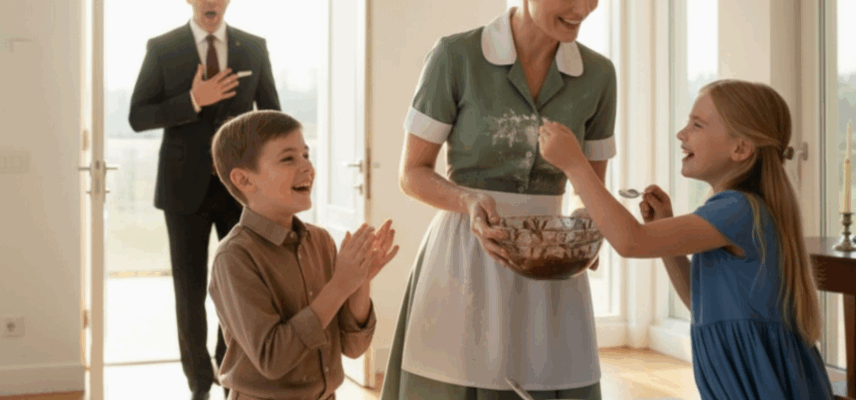
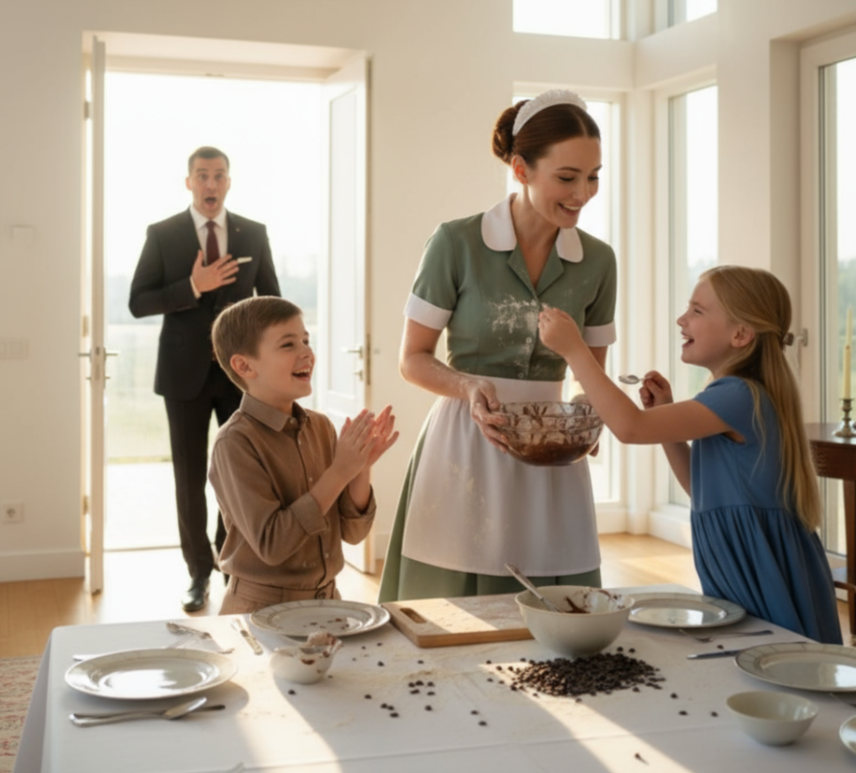
The table was a cheerful mess of flour, frosting, and sliced fruit. The smell of chocolate filled the air. Lucas stood on a chair, proudly decorating a cake with strawberries, while Maya giggled at his clumsy concentration. Sofia stood among them, her uniform dusted with flour, hair pinned back, laughing as she wiped frosting from Maya’s cheek.
They weren’t merely being looked after — they were at play together, a small, messy circle of belonging.
Nathan stood in the doorway, startled by how alive the house sounded. A tightness rose in his throat. In Sofia’s easy laughter he heard a warmth that made him think of Elena. Her presence with the children showed him, with painful clarity, what he’d been missing.
Sofia turned when she saw him. The children stopped mid-laugh, unsure if they’d done something wrong. Nathan walked in slowly and, with a voice barely above one of the kids’, said, “Thank you.”
Before he could say more, Lucas and Maya ran into his arms. He hugged them harder than he had in years; tears slid down his face. For the first time in a long time, his children saw their father cry.
That night he didn’t return to the office. They ate a simple dinner Sofia served and sat at the same table — the children chattering about school and cake, Nathan listening for the first time in a long while.
It began to change things. He started coming home earlier. He joined baking sessions, read bedtime stories, and took evening walks. The mansion slowly shed its museum-like silence and filled with ordinary life: cookies cooling on counters, drawings on the refrigerator, laughter echoing through the halls.
Nathan began to notice Sofia not just as an employee but as a person of quiet strength. One evening, after the children were asleep, he found her by the window. In the moonlight he learned something that made her earlier tenderness make sense: she had once lost a child, a little boy around Lucas’s age. Perhaps, Nathan realized, she’d been loving his children partly to mend her own grief.
“You’ve done more for my children than I have,” he said softly.
Sofia shook her head. “You’re here now, Mr. Hale. That’s what they need.”
Her words stayed with him. Over the months the house grew warmer still. Lucas’s drawings covered the fridge; Maya’s laughter threaded through rooms. Sofia became more than a caretaker — she became family.
One evening, Nathan stood in the doorway as he had that first time, watching Sofia dance with the children under the chandelier’s glow. Tears filled his eyes again, but these were not guilty ones; they were full of gratitude.
The ordinary day he’d chosen to come home early had changed everything. He’d left the office to escape exhaustion and found, instead, love and life waiting at the end of his drive.
Note: This work is inspired by real events and people but has been fictionalized for creative purposes. Names, characters, and details have been altered to protect privacy and enhance the narrative. Any resemblance to actual persons or events is coincidental.