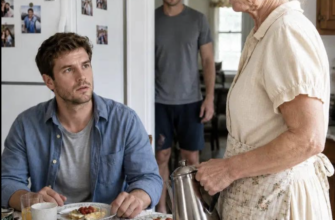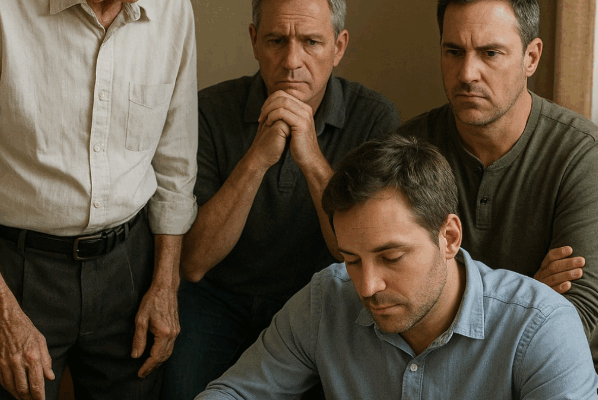
The day my father came home from the hospital, he said almost nothing. He moved slowly, more stooped than I remembered, his hair completely gray. Without a word he set a single sheet of paper on the table.
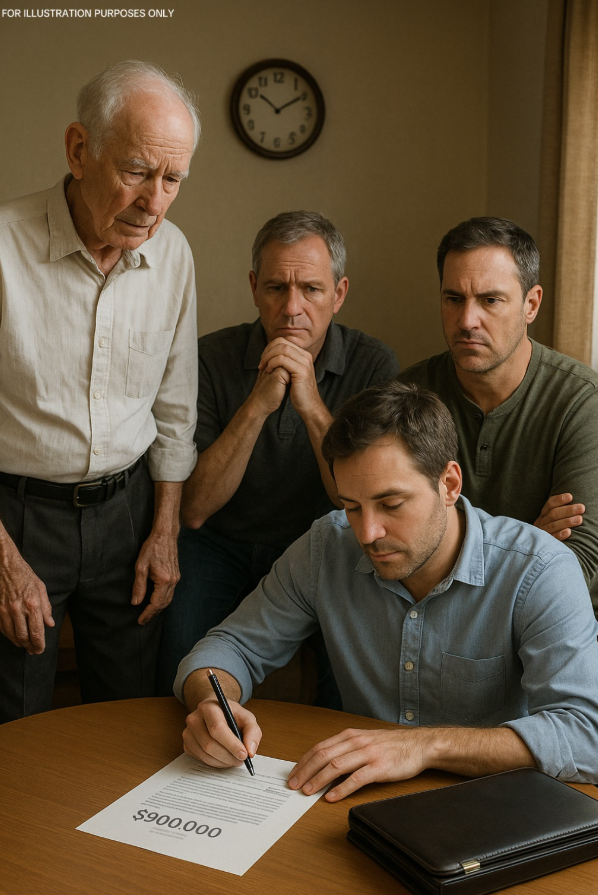
It was a promissory note for \$900,000—his name as the debtor.
My two older brothers and I stared at it, stunned. For a long moment only the clock on the wall broke the silence.
My eldest was the first to speak. He shook his head. “I can’t, Dad. All my money’s going to the kids’ college. You know how expensive that is.”
The middle brother followed quickly. “I just opened the hardware store. I don’t even have working capital yet. There’s no way I can take this on.”
They both turned to me—the youngest, newly married, still paying a mortgage. My wife and I had been planning a modest, steady life. Still, when I saw my father’s frail shoulders and tired eyes, I knew what I had to do.
“I’ll take it,” I said, my voice barely steady.
My brothers looked at me as if I’d lost my mind. My father’s mouth softened into a small smile. I signed the note and slipped it into my briefcase.
That week I brought him to live with us. If he was to bear such a burden, I wanted him nearby. I wanted to care for him.
Life changed. I worked from dawn until long after dusk, took extra shifts, did odd jobs—anything to make the payments. Some nights our dinner was boiled beans. My wife stopped buying clothes and even sold the motorcycle we had bought with pride months earlier. We tightened every belt, counted each penny, and lived humbly.
But there were quiet rewards. I would return home, exhausted, and find my father in the courtyard with our children on his lap, telling stories. Sometimes a rare, genuine smile would cross his face—soft and almost childlike. Those moments made the hardship feel worthwhile.
Exactly one year after I signed the note, my father called me into his room. He sat at his desk and, with hands that trembled slightly, removed a folded paper from a drawer and laid it before me.
“Read it,” he said.
I unfolded it, bracing for another bill. My breath stopped.
It was a will.
In neat, measured handwriting he had left me the entire three-story house in the city center and a 300-square-meter plot of land in the most commercial district of town.
I froze. My hands shook. My father looked at me, warmth in his eyes.
“All my life,” he said softly, “I wanted to know who would stand by me when it mattered most.”
At that moment, footsteps sounded at the door. My two brothers had overheard. Their faces—earlier indifferent—shifted to shock, then regret.
“Dad… why did you do that?” the eldest asked, voice tight. “We’re your children too.”
My father’s tone was calm, firm. “I know each of you has struggles. But when I truly needed help, only the youngest had the courage to shoulder the burden. This house and this land are his reward for that sacrifice.”
The second brother opened his mouth and found no words. They left the room quietly, their sandals scrubbing the floor.
I sat there, the will trembling in my hands. My father reached across the table and squeezed my shoulder with a weathered palm.
“You don’t have to pay that debt anymore,” he said gently. “That money… was a test. I settled it long ago.”
The room spun as the truth settled in. The year had not been about money but about loyalty, sacrifice, and love. My father had wanted to know—through actions, not words—who among his children would choose family.
I wept then, not just in relief but at the weight of what the past year had revealed.
News of the will spread through our extended family the next day. Some called my father wise for testing us; others said it was unfair. None of that mattered to me. I continued to care for him as I had been doing.
Because the greatest inheritance was not the house or the land. It was his trust.
Sometimes at night I pass the courtyard and see my father asleep in his chair with my children curled beside him. I think back to the day he put that promissory note on the table. It had looked like a curse—a crushing debt. In truth it became the greatest blessing I’ve known: it taught me resilience, drew my family closer, and let me show my father, by deeds, that I loved him.
The land and house are valuable, yes. But the trust he gave me is worth more than any property—and that is something no one can ever take away.
This piece was inspired by stories from everyday lives and written by a professional writer. Any resemblance to actual names or locations is purely coincidental.