Patricia Salazar was finishing her shift, wiping down the floor-to-ceiling windows in a luxurious executive office, when she noticed an elegant gold envelope on the mahogany desk. The thick paper, embossed lettering, and wax seal seemed out of place—almost threatening.

She was twenty-three and had spent two years cleaning offices in one of Mexico City’s tallest corporate towers. She’d perfected the art of invisibility, moving quietly, never interrupting, making herself small so others wouldn’t be inconvenienced. She learned to read people without speaking—some walked past as if she were air, others looked at her like unwanted furniture, and very few saw her as human.
Sebastián Vargas was not one of those few.
He entered with the confidence of someone born into privilege—thirty years old, three companies bearing his name, and a smile that was polished yet utterly cold. He handed her the gold envelope with theatrical gentleness.
«I want you to have this,» he said. «It’s an invitation to a charity gala next week. The most exclusive event of the season.» He paused, watching her reaction. «I thought it might be… educational for you. To see how successful people live.»
His words were smooth, but the meaning was sharp. He added that it was very formal—floor-length gowns, proper etiquette. «I’m sure you’ll manage something… appropriate,» he said with a slight smile before walking away.
Patricia felt her chest tighten as she read the details. A dinner costing more than her yearly rent. An auction with bids she couldn’t pronounce without laughing. This wasn’t an invitation—it was a setup. She was meant to be the joke.
The Decision
That night, her roommate Sofía examined the card under the kitchen light. «This makes no sense,» she said flatly. «Sebastián Vargas doesn’t do ‘nice.’ He wants to embarrass you. He wants you to show up in something you can barely afford so people can stare, judge, and whisper while he laughs.»
«Then I won’t go,» Patricia said quietly.
Sofía squeezed her hand. «Or you go—and you rewrite the ending.»
Patricia’s fingers instinctively touched the small gold heart pendant at her neck—the last thing her mother had given her before she passed away. Sofía suggested pawning it temporarily to buy a proper dress. The idea hurt deeply, but beneath the pain, something else stirred: defiance.
The next day, Patricia went to a pawn shop that smelled of desperation. When the appraiser offered 500 pesos for the chain, she signed with tears in her eyes, refusing to look back as she left.
The Transformation
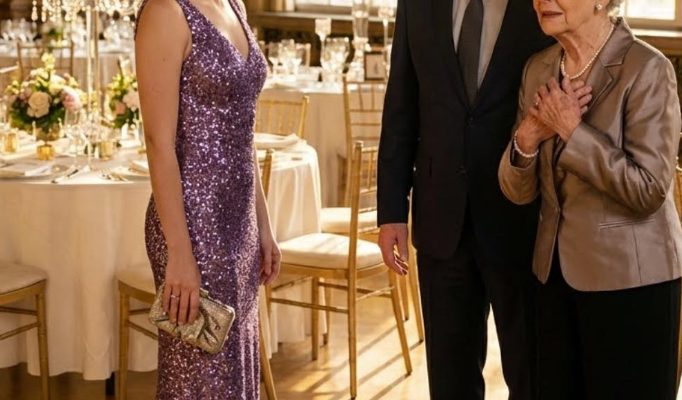
With the money, she found a beautiful purple dress in a secondhand shop—elegant with understated sequins, like a starry night. The saleswoman, sensing her story, sold it to her for 450 pesos instead of 800.
When Patricia tried it on, she stood still before the mirror. She didn’t see the cleaning lady anymore. She saw a woman with poise, with lively eyes, with a beauty that had always been there, hidden beneath uniforms and exhaustion.
She bought simple sandals, had her hair done at a local salon, and practiced her manners by watching videos. At work, Sebastián noticed her distraction and muttered sarcastically, «Thinking about the gala, Patricia? I hope you don’t waste your savings on nonsense.»
She took a deep breath. «Don’t worry, Mr. Vargas. I’ll be there.»
Surprise crossed his face. Patricia understood something in that moment: men like him fed on other people’s fear. And she had just refused to give it to him.
The Night of the Gala
The night before the event, her grandmother Guadalupe called from Oaxaca. When Patricia mentioned her nervousness, her grandmother shared something important: «Your mother worked as a maid her whole life, but she had more class than many ladies wearing jewels. She worked for the Mendoza Reyes family—an important family. The lady of the house greatly appreciated your mother’s intelligence and manners.»
These words stayed with Patricia like a talisman.
On the day of the gala, Patricia bathed as if shedding the past, applied subtle makeup, gathered her hair in a low bun, and put on the purple dress. When Sofía saw her, she was speechless. «You’re going to make him choke on his own poison.»
At the country club, luxury cars deposited men in tuxedos and women in extravagant dresses. Patricia stepped out of her ride-hailing vehicle and felt curious glances. Inside, everything—the chandeliers, imported flowers, porcelain—seemed designed to remind some they belonged and others they didn’t.
When Sebastián saw her, his smile faded like a candle going out. For the first time, he didn’t see the cleaning lady. He saw a woman.
The Unexpected Connection
Patricia approached him calmly. «Good evening, Mr. Vargas.»
«Did you… manage to come?» he stammered.
«You invited me,» she replied simply.
One of his friends, Javier Torres, extended his hand with genuine interest. When asked about her work, Patricia took a risk: «Administration. I’m finishing my degree in human resources management.»
Sebastián tensed, but before he could intervene, an elegant woman approached—Victoria, about fifty years old, with a warm smile. She noticed Patricia’s necklace and asked about it.
«It belonged to my mother,» Patricia said.
Victoria paled. «What was your mother’s name?»
«Carmen Salazar.»
Victoria’s eyes filled with tears. «My God… are you Carmen’s daughter? Your mother worked for my family. She was one of the most special people I’ve ever known.»
Everything clicked into place—Mendoza Reyes, Victoria, Carmen, and Patricia, an unexpected bridge between past and present.
The Public Humiliation Backfires
The dynamic of the room shifted. Victoria took Patricia’s hand naturally and asked about her work. Patricia could have lied, but something in Victoria’s eyes reminded her of her mother.
«I work as a cleaner while I finish my degree.»
«Just like your mother,» Victoria said proudly. «She worked during the day and studied at night.»
Sebastián tried to exploit this. «Victoria, you may not know, but Patricia cleans my office.»
Victoria looked at him with icy clarity. «And what’s the problem with that? Are you suggesting honest work is shameful? Your own grandmother was a seamstress, Sebastián. One’s origins are not to be denied—they are to be honored.»
Sebastián turned red, trapped by his own cruelty.
The Turning Point
During the charity auction, a lot of business administration books appeared with a starting bid of 500 pesos—exactly what Patricia had at home. Her heart raced. Those books could change her semester, maybe her entire career. Without overthinking, she raised her hand.
«Five hundred.»
No one else bid. Sold.
Sebastián saw his last chance for revenge. He walked to the microphone. «Friends, I want to comment on the previous auction. Miss Patricia Salazar, who won the books for 500 pesos, works as a cleaner in my office.»
The room froze. Patricia felt the blood rush to her face. The impulse was to run and be invisible again. But instead, she stood up slowly, breathed deeply, and spoke.
«Mr. Vargas is right. I am a cleaner. And I am proud of my job. Yes, 500 pesos is a lot of money for me. But my mother taught me that education is the only investment that never loses value. I’ll work overtime if necessary. Because that’s how honest people do things.»
A different kind of silence fell—not mockery, but recognition. Roberto Martínez, a businessman, stood and began to applaud. Gabriela Fernández followed. Victoria too. Within seconds, the entire room was on its feet.
Sebastián stood frozen, his humiliation turning against him like a mirror.
When the applause subsided, Roberto leaned toward Patricia. «I want to offer you a junior position in human resources at my company. Good pay, flexible hours so you can continue your studies.»
«I accept,» Patricia said—and for the first time, that word was not submission, but choice.
The Aftermath
At the end of the event, Sebastián approached alone. «I need to apologize. It was mean. Cruel.»
Patricia looked at him without hatred. «You have everything money can buy, but you have no character. If you want to change, start by treating your employees like human beings.»
At the exit, Victoria placed an envelope in her hands. «Your mother left this with me. She asked me to give it to you if I ever found you. Open it at home. She would be proud of you today.»
At the apartment, Patricia opened the envelope to find a handwritten letter and a savings account book. Her mother had saved every penny thinking of her future, with a message: «Never be ashamed of honest work, but never accept being treated with less respect than you deserve.»
Patricia cried—not from sadness, but from relief.
The next morning, she retrieved her mother’s chain from the pawn shop. A week later, she started her new job. She didn’t forget where she came from—she used that memory as her compass, suggesting improvements for cleaning staff. Surprisingly, Sebastián implemented several, perhaps out of guilt, perhaps from awakening.
Months later, Patricia no longer walked hunched over. Her dignity had been restored—not given by anyone else, but reclaimed by herself.