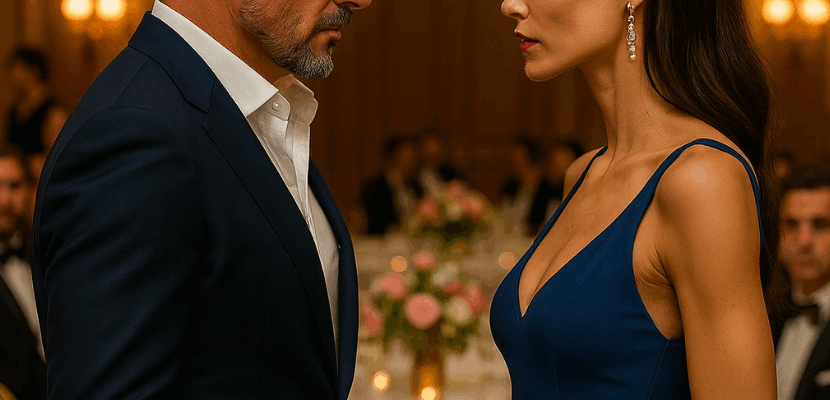
“I won’t take you there. There will be decent people there—people not at your level,” my husband announced, not knowing I owned the company he worked for.

The bedroom mirror gave me the same small, familiar scene: I was straightening the pleats of a modest gray dress I’d bought three years earlier at a regular shop. Dmitry stood nearby, fussing with the cufflinks on his snow-white shirt—Italian, as he never tired of pointing out.
“Ready?” he asked without looking at me, busying himself by wiping nonexistent dust from his suit.
“Yes. Let’s go,” I said, checking one last time that my hair was neat.
He finally looked at me and, as always, I saw that half-familiar expression of mild disappointment. Dmitry appraised me in silence, lingering on the dress.
“Don’t you have anything more decent?” he asked, his voice threaded with the usual condescension.
I’d heard that before before every company event. Each time it stung—never fatal, just sharp. I had learned not to show the hurt. I learned to smile and shrug.
“This dress fits me,” I said calmly.
Dmitry sighed as if I had failed him once again. Fine. Let’s go. Just try not to draw attention to yourself, he added.
We married five years earlier: I’d just finished my economics degree and he was a junior manager at a trading firm. Back then he’d seemed ambitious and determined. I liked how he spoke of the future, the confidence in his plans.
Over the years he climbed the ladder. Dmitry was now a senior sales manager handling important clients. He spent his money on his image: expensive suits, Swiss watches, a new car every two years. “Image is everything,” he said. “If you don’t look successful, they won’t hire you.”
I worked as an economist at a small consulting firm, earning a modest wage and keeping the household budget in check. At company events I always felt out of place. He would introduce me with a light irony: “Here’s my little gray mouse on a walk.” Everyone laughed. I smiled and pretended it amused me.
Gradually I began to notice a change: success had gone to his head. He started looking down not only on me but on his bosses. “I sell this junk from our Chinese suppliers,” he’d say at home over expensive whiskey. “It’s all about presentation; people will buy anything.”
Sometimes he hinted at extra income. “Clients appreciate good service,” he would wink. “And they’ll pay more for it. I understand that, don’t I?”
I understood but didn’t ask for details.
Everything changed three months ago when a notary called.
“Anna Sergeevna? It’s about your father’s inheritance—Sergei Mikhailovich Volkov.”
My heart sank. My father had left when I was seven. My mother never spoke of him. All I knew was he’d gone to a life that had no room for a daughter.
“Your father passed away a month ago,” the notary continued. “According to the will, you are the sole heir.”
At the notary’s office I learned the truth. My father hadn’t been merely successful—he’d built an empire: an apartment in central Moscow, a country house, cars, and, most importantly, an investment fund with shares in dozens of companies.
Among the documents I found the name that made my hands tremble: TradeInvest—the company where Dmitry worked.
The first weeks were a blur. I told Dmitry only that I’d changed jobs and was now in the investment sector. He shrugged, muttering that he hoped my salary wouldn’t fall.
I began studying the fund. My economics training helped, but more than that I felt engaged—useful for the first time. I wanted to understand everything.
I took a particular interest in TradeInvest and asked for a meeting with the CEO, Mikhail Petrovich Kuznetsov.
“Anna Sergeevna,” he said in his office, “I’ll be frank: the company isn’t in great shape. The sales department is particularly problematic.”
“Go on,” I said.
“We have an employee—Dmitry Andreev. On paper he handles important clients; turnover is high but profit is almost nil. Many deals are unprofitable. There are suspicions of violations, though evidence is incomplete.”
I requested an internal investigation without revealing why I was so focused on that particular employee.
A month later the results came in. Dmitry was embezzling company funds—agreeing to “personal bonuses” with clients for lower prices. The sum was significant.
By then I’d refreshed my wardrobe. True to myself, I chose understated pieces—now from the world’s top designers. Dmitry didn’t notice. To him, anything that didn’t shout price was still “a little gray mouse.”
The night before the presentation dinner for senior management, he announced, “It’s an important event. The entire company management will be there.”
“What time?” I asked.
He looked at me with something like pity. “I won’t take you. There will be decent people there, not of your standing,” he said, unaware I was the owner of the company he worked for. “You understand—this is serious. People will be deciding my fate. I can’t afford to look… well, you know.”
“Noted,” I said.
“Anyechka,” he tried to soften his tone, “you’re a wonderful wife, but you lower my status. Next to you I look poorer. These people must see me as their equal.”
His words pinched, but not like before. Now I knew my worth. And his.
“Fine,” I said. “Have fun.”
That morning Dmitry left in a buoyant mood. I slipped into a new Dior dress—dark blue, elegant, flattering yet restrained. Makeup and hair done professionally, I looked in the mirror and saw someone confident, successful.
The dinner was at one of the city’s finest restaurants. Mikhail Petrovich greeted me at the entrance.
“Anna Sergeevna—glad you could come. You look wonderful.”
“Thank you. I hope today we can sum up and plan.”
The room was full of people in expensive suits and dresses; the tone was formal but warm. I spoke with department heads and key employees. Many already knew me as the new owner, though it wasn’t public yet.
I saw Dmitry as soon as he entered—his best suit, a new haircut, that measured confidence. He scanned the room, appraising his peers.
Our eyes met. At first he didn’t understand. Then recognition washed over his face, followed by disbelief and finally panic. He came straight to me.
“What are you doing here?” he hissed. “I told you this isn’t for you.”
“Good evening, Dima,” I replied.
“Get out of here! You’re embarrassing me!” His voice dropped to a hiss. “And what is this charade—using your rags to humiliate me?”
People began to notice. Dmitry tried to compose himself. “Don’t make a fuss. Go quietly and we’ll talk at home,” he murmured.
Mikhail Petrovich was standing beside us. “Dmitry, I see you’ve met Anna Sergeevna,” he said with a pleasant smile.
“Mikhail Petrovich,” Dmitry switched to obsequiousness, “I didn’t invite my wife. Honestly, it’d be better if she went home—this is a business event.”
“Mikhail” looked surprised. “But I invited Anna Sergeevna. She isn’t going anywhere. As the owner, she must be present.”
I watched as the realization settled into Dmitry—confusion, recognition, horror. He paled.
“Owner… of the company?” he whispered.
“Anna Sergeevna inherited the majority stake from her father,” Mikhail Petrovich continued. “She’s now our largest shareholder.”
He stared at me as if seeing me for the first time. Panic filled his eyes. He knew that if I saw evidence of his schemes, his career would be done.
“Anya…” he began in a voice I’d never heard—pleading, frightened. “We need to talk.”
“Sure,” I said. “But first, let’s hear the reports. That’s why we’re here.”
The next two hours were torture for him. He sat beside me, attempting to eat and converse, but his hands trembled every time he raised his glass.
After the formal portion, he pulled me aside. “Anya, listen,” he said rapidly, cajoling. “Maybe someone told you—maybe it’s not entirely true. I can explain!”
That humiliated, pleading tone disgusted me more than his former arrogance. At least then he had been honest in his contempt.
“Dima,” I said quietly, “you can leave the company and my life quietly and with dignity. Think about it.”
Instead he exploded. “What are you playing at?!” he shouted, ignoring the crowd. “You think you can prove anything? You have nothing! It’s speculation!”
Mikhail Petrovich signaled security. “Dmitry, you’re disturbing the peace. Please leave.”
“Anya!” Dmitry shouted as guards escorted him out. “You’ll regret this!”
A real scene awaited at home.
“What was that?!” he shouted, pacing and flinging his arms, his face flushed. “What the hell were you doing there? Trying to set me up? An act?!”
“You won’t prove anything,” he barked. “It’s all your inventions and intrigues. I won’t let an idiot control my life—”
“Dima,” I interrupted, calm, “the internal investigation started two months ago—before you knew who I was.”
He froze, then narrowed his eyes.
“I gave Mikhail Petrovich the chance to let you resign without consequences,” I continued. “Apparently that offer wasn’t accepted.”
“What are you talking about?” His voice dropped, angry but unsure.
The investigation showed that over three years he had embezzled about two million rubles—likely more. There were documents, recorded calls with clients, and bank transfers. Mikhail Petrovich had already handed the file to the authorities.
Dmitry slumped into an armchair, defeated. “You… you can’t,” he muttered.
“If you’re lucky,” I said, “you can negotiate compensation. The apartment and the car should cover it.”
“You idiot!” he spat. “Where will we live then? You’ll leave me with nothing!”
I looked at him with pity. Even now he thought only of himself.
“I have a downtown apartment,” I said quietly. “Two hundred square meters. And a house in the Moscow region. My personal chauffeur is already waiting downstairs.”
He stared as if I were speaking another language. Confused, broken, pathetic—the same man who that morning had deemed me unfit among decent people.
“You were right, Dima,” I told him. “We are on different levels. Just not the way you imagined.”
I closed the door and didn’t look back.
Downstairs a black car waited. In the back seat I watched the city pass; it looked unchanged, but I had changed. My phone rang. Dmitry. I declined.
Then a text arrived: “Anya, forgive me. We can work this out. I love you.”
I deleted it without reply.
A new life awaited in a new apartment—one I should have begun years ago but never knew I could. Tomorrow I would decide what to do with the company, the fund, and my father’s estate. My future depended on my choices now.
And Dmitry would be in the past—along with every humiliation, doubt, and smallness he had given me.
I am no little gray mouse. I never was.
This piece is inspired by readers’ everyday stories and written by a professional writer. Any resemblance to real names or places is coincidental.