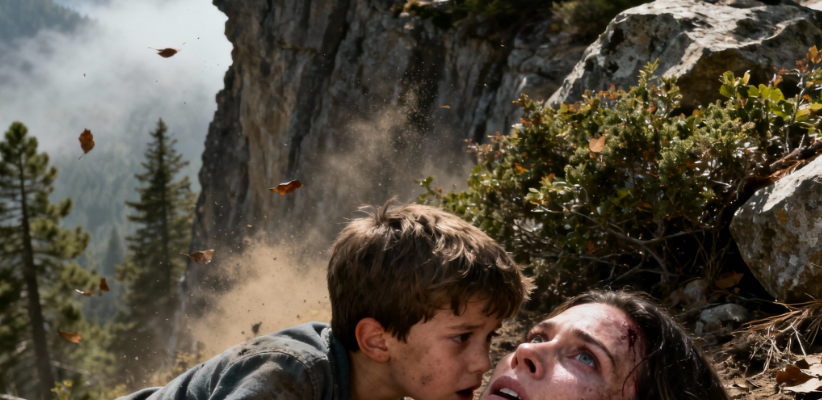
My family took us hiking that day. We thought it was supposed to be a simple outing. Instead, without a single hint or warning, my parents and my sister shoved me and my six-year-old son off a cliff. I hit the slope hard, unable to breathe, while Owen crawled to me and whispered, “Mom… don’t move yet.” We decided to lie completely still—to pretend we were dead. And when they finally walked away, Owen told me what my sister had said. The words froze me with a terror I didn’t know was possible.

That morning, everything looked ordinary.
Early autumn near Asheville meant damp leaves, crisp air, and a trail my father promised would be “easy.” Owen skipped ahead with his tiny backpack, trusting everyone the way children do when they’re surrounded by people they were taught to love. I tried to match his enthusiasm, even though a knot of dread had been twisting inside me since dawn.
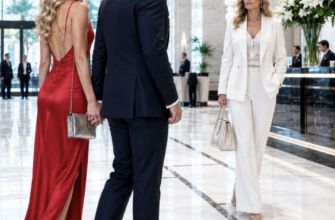
My parents were overly cheerful. My sister, Kendra, kept hovering—offering to hold Owen’s hand, insisting on taking pictures, forcing a performance of a family that had never really healed.
Halfway up the trail, my phone lost signal. My mother smiled.
“Good. Now no distractions.”
It should’ve sounded nice. Instead, it felt like a cue.
We reached an overlook where the forest opened into a steep valley. A low stone barrier marked the edge. My dad moved behind me like he was lining up a photo. My mom called out, “Stand right there, Ava. The light is perfect.”
I stepped forward with Owen. Kendra slid in next to him, one hand resting on his shoulder.
And then everything snapped.
A violent shove slammed into my back. My mother grabbed my arm and pulled. Kendra shoved Owen hard—too hard for a six-year-old to catch his balance.
The world disappeared beneath us.
There was no time to scream. Only time to twist, to reach for my son, to feel the air tear past us as the cliff dropped away.
We didn’t fall far—a steep slope broke our plunge. I rolled through rocks and dirt, pain exploding through my ribs. Owen slid until a fallen log stopped him.
Above us, I heard voices—my family’s silhouettes leaning over the edge.
My mother called down, her panic theatrically fake, “Oh no! They slipped!”
My dad shouted for anyone nearby to hear, “Ava! Are you okay?!”
I couldn’t answer. My breath was thin and sharp. Owen crawled to me, his face streaked with dirt, his eyes wide but shockingly steady.
He pressed his face close to mine and whispered, “Mom… don’t move. Pretend we’re dead.”
I didn’t understand until I heard my father’s voice drop its performance.
“I can’t tell from here. Are they…?”
And Kendra answered, her voice cutting through the trees:
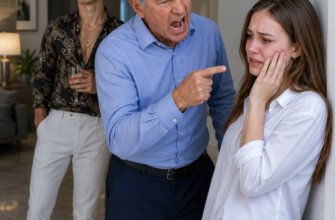
“If she’s still breathing, I’ll go down there and finish it.”
My entire body turned to ice.
I forced myself to stay utterly still. Owen pressed closer, blocking their view, keeping his breathing shallow—too controlled for a child. He wasn’t panicking. He was protecting us.
More voices floated down.
My mother: “Stop worrying. They’re gone.”
My father: “Check anyway.”
Kendra: “I swear I saw her move.”
A rock tumbled near my leg. I didn’t flinch.
Footsteps shifted—someone looking for a way down.
Owen whispered, “If she comes down here, I’ll hide in the bushes. Don’t grab me, Mom. If you touch me, she’ll see.”
He sounded far older than six.
Branches snapped. Kendra appeared on the slope, climbing toward us. She crouched beside Owen first, reaching for his neck with two fingers.
He didn’t move.
Then she checked me. Her shadow covered my face. Her fingers brushed near my pulse, and for one agonizing moment I thought she’d feel it.
She hesitated.
Then she called up, “They’re cold. I think it’s over.”
And then—words that revealed everything:
“She had to be out of the way before the trustee meeting. If Ava’s gone, Mom gets control. If she lives, we get nothing.”
It wasn’t rage. It was strategy.
When she climbed back up, Owen opened his eyes and finally breathed.
“They’re gone,” he whispered. Then he added, trembling, “Mom… Aunt Kendra said you have to die before Thursday.”
My stomach dropped.
Thursday—the trustee meeting my grandfather’s attorney had scheduled.
They hadn’t pushed me in the heat of the moment.
It was a planned execution.
We made our way down the slope, inch by inch, hoping to reach a lower trail. When we finally heard distant hikers, Owen blew the whistle from his backpack—three sharp blasts.
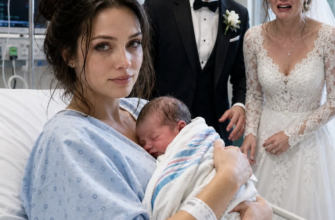
Help arrived. Paramedics. Police. Questions I could barely answer.
At the hospital, Officer Jenna Alvarez took our statements. Owen’s voice shook as he repeated Kendra’s words:
“She said if Mom was still breathing, she’d finish it. She said if I remembered… they’d have to take me too.”
The officer’s jaw tightened. “Thank you,” she told him. “You helped save your mom.”
Then my phone buzzed.
An email from the estate attorney:
Your mother has submitted an emergency request claiming you are incapacitated and asking for immediate authority over your assets. Please verify your condition.
My hands trembled.
They had already started the paperwork—before confirming whether I was alive.
Officer Alvarez photographed the email. “This just became very serious,” she said.
Rangers found my family’s SUV abandoned at the trailhead—plates smeared with mud.
They were already running.
The next days were a blur of CT scans, police interviews, protective orders, and meetings with my lawyer. A freeze was placed on the trust. My mother’s emergency request was invalidated. Arrest warrants were issued for all three.
Owen slept beside me every night in the hospital, waking at the sound of every door, scared they might come back.
When Thursday came, I attended the trustee hearing by video—arm in a sling, bruises dark across my skin. Owen sat beside the victim advocate, clutching his whistle.
My mother’s request for control was rejected. The trustee reinstated my authority. The judge issued no-contact orders and reinforced the warrants.
When it was over, I stepped out of the courthouse room trembling—not from fear this time, but from the weight of surviving something designed to erase us.
Not because my family hated me.
But because they thought I was standing between them and money.
And because they decided my son was expendable.